

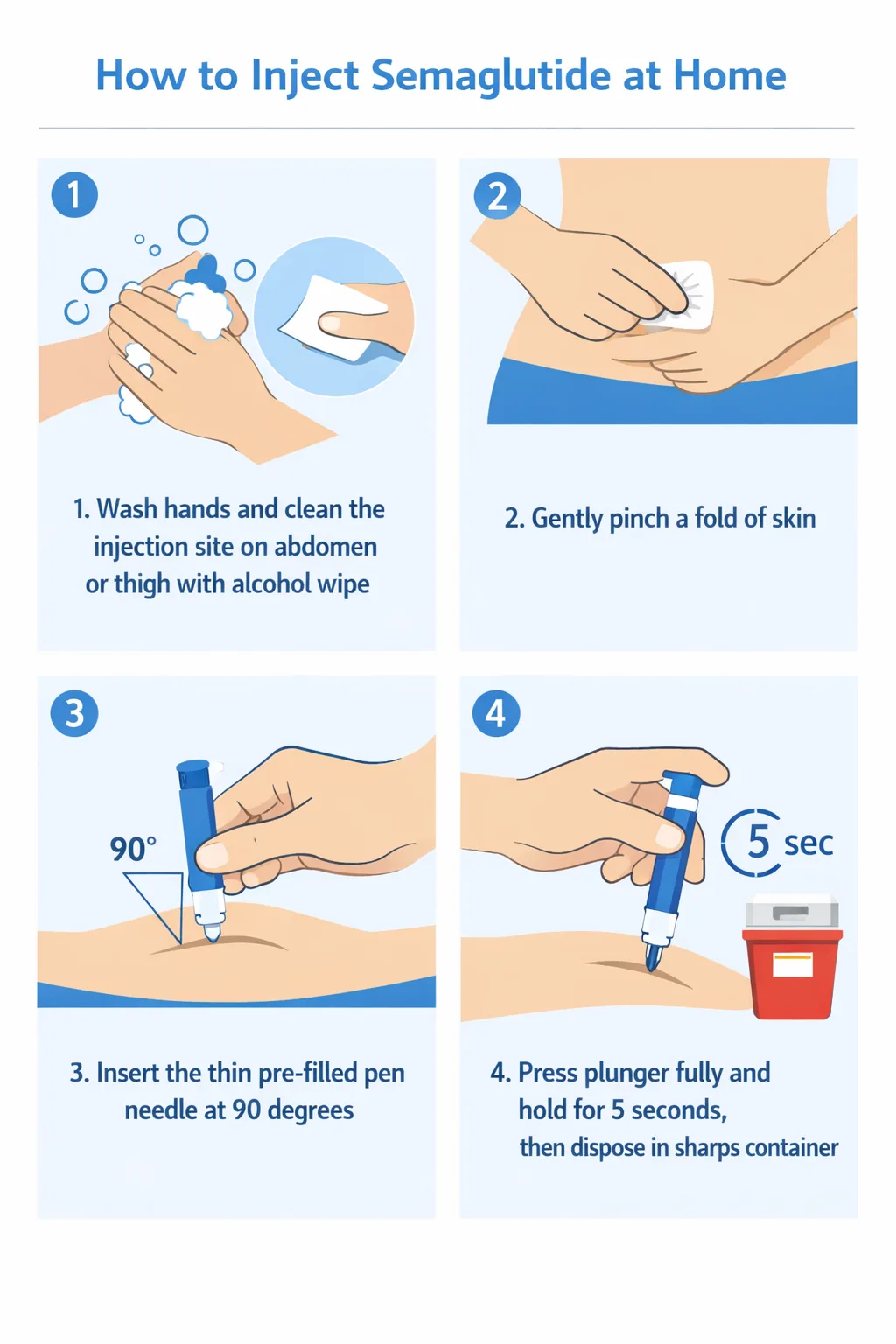
Direct answer: semaglutide is injected once a week into the fat layer just under the skin — the abdomen (at least two inches from the navel), the front of the thigh, or the back of the upper arm. Clean the site, pinch a fold of skin, insert the needle at 90 degrees, deliver the dose slowly, count to six before withdrawing, and use a different spot within the same area next week. Below, Dr. Bismah Irfan, MD walks through the full procedure for both the prefilled pen and the compounded vial-and-syringe setup, the way she teaches it to her IVitality MD patients.
Pen or Vial? Check What You Were Given First
Semaglutide reaches patients in two forms, and the injection routine differs slightly between them. Brand-name products (Ozempic, Wegovy) come as a prefilled pen: the medication is already dissolved, and you dial your dose with a selector. Compounded semaglutide from a pharmacy usually arrives as a small vial — either ready-to-inject solution or a dry powder that has to be dissolved first. If yours is a powder, start with our guide on how much bacteriostatic water to mix with 5 mg of semaglutide, then come back here for the injection itself.
With a vial, the dose is measured in units on a U-100 insulin syringe. At the standard 1 mg/ml concentration, a 0.25 mg dose is 25 units and a 0.50 mg dose is 50 units. If syringe markings are new to you, our guide to reading insulin syringe units covers them in detail.
How to Inject Semaglutide With a Prefilled Pen
- Check the pen. The label should show semaglutide and your prescribed strength, and the solution should be clear and colorless. Do not use a pen that looks cloudy or has particles in it.
- Wash your hands and attach a fresh needle. Tear the paper tab off a new needle, push and twist it onto the pen until snug, then remove both needle caps.
- Do the flow check (first use of each new pen). Turn the dose selector to the flow-check symbol, hold the pen needle-up, and press the dose button until the counter reads zero. A drop should appear at the needle tip — that confirms the pen is delivering medication.
- Choose and clean your site. Abdomen, front of the thigh, or back of the upper arm. Wipe the skin with an alcohol swab and let it dry.
- Dial your prescribed dose. Turn the selector until the counter shows the exact dose your prescriber set.
- Inject. Insert the needle fully into the skin at 90 degrees, press and hold the dose button until the counter returns to zero, then keep the needle in place while you slowly count to six. This pause matters — pulling out early can let part of the dose leak back out.
- Withdraw and dispose. Pull the needle straight out, unscrew it from the pen, and drop it into a sharps container. Never leave a used needle attached to the pen between doses.
How to Inject From a Compounded Vial With an Insulin Syringe
- Swab the vial stopper with an alcohol wipe and let it air-dry for about ten seconds.
- Draw air into the syringe equal to your dose (for a 25-unit dose, pull the plunger to 25 units), then push that air into the vial. This keeps the pressure balanced and makes drawing the liquid easier.
- Turn the vial upside down with the syringe still in it, keep the needle tip below the liquid level, and pull the plunger slightly past your dose mark.
- Clear the bubbles. Tap the syringe barrel so air bubbles rise to the top, then gently push the plunger to your exact unit mark. Air in the syringe means less medication delivered, so take a few seconds here.
- Confirm the number. Check the unit count against the written instructions from your prescriber before every injection, not from memory. If the vial label shows a concentration other than 1 mg/ml, the unit math changes — ask your prescriber to write out the conversion.
- Inject. Clean the site, pinch a fold of skin, insert the needle at 90 degrees (your prescriber may suggest 45 degrees if you are very lean), press the plunger slowly all the way down, count to five, then withdraw. Do not rub the spot afterwards.
- Dispose of the whole syringe in a sharps container. Insulin syringes are single-use.
Where to Inject Semaglutide — and How to Rotate Sites
The three approved areas are the abdomen (staying at least two inches away from the navel), the front of the thighs, and the back of the upper arms. All three absorb the medication comparably well, so pick whichever you can reach comfortably — most people settle on the abdomen because it is the easiest to see and pinch.
Rotation is the part patients skip, and it is the part that keeps skin healthy. Injecting the same spot week after week can cause lipohypertrophy — a firm, fatty lump under the skin that also absorbs medication unpredictably. The simple system Dr. Irfan recommends: stay in one area, but move each injection at least one finger-width away from the previous spot. Some patients mentally divide the abdomen into four quadrants and use one per week. Avoid scars, moles, bruised skin, and the line where a waistband presses.
When Is the Best Time to Inject Semaglutide?
Semaglutide is taken once every seven days, and consistency matters more than the clock: the same day each week, at whatever time fits your routine, with or without food. Anchoring the injection to a fixed weekly habit — Sunday evening, Wednesday before breakfast — makes it much harder to forget.
If you do miss a dose, the manufacturer’s guidance for Ozempic is to take it within 5 days of the missed day, and to skip it entirely if more than 5 days have passed, resuming on your regular day. Rules differ between products and compounded protocols, so confirm the missed-dose rule with your prescriber rather than borrowing one from a different medication. Dosing levels themselves are covered in our guide to semaglutide dosage for weight loss in non-diabetics.
What’s Normal After the Injection — and What Isn’t
A brief sting, a tiny drop of blood, or slight redness at the site is normal and fades within a day. The most common systemic side effects — nausea, vomiting, diarrhea — come from the medication itself, not from injection technique, and tend to be strongest in the first weeks or after a dose increase. Having them does not mean you injected incorrectly.
Call your prescriber if redness spreads, the site becomes warm and painful, side effects are severe or persistent, or you notice signs of an allergic reaction such as rash, swelling, or trouble breathing — the last of these warrants urgent care, not a scheduled call.
Common Injection Mistakes
- Injecting cold medication straight from the fridge. Cold solution stings noticeably more. Let the pen or drawn syringe sit at room temperature for 15–30 minutes first. Storage rules are covered in does Ozempic need to be refrigerated.
- Using the same spot every week. This is the main cause of lumps, irritation, and erratic absorption. One finger-width away, every time.
- Skipping the flow check on a new pen. Without it, the first dose from a pen can be incomplete.
- Not pausing before withdrawing. Count to six with the needle still in — early withdrawal lets medication leak back out and effectively shrinks your dose.
- Reusing needles or syringes. A reused needle is duller, more painful, and a contamination risk. One needle, one injection.
- Tossing loose needles in the trash. Used sharps go in an FDA-cleared sharps container or a heavy plastic bottle with a screw lid, sealed and labeled before disposal.
Storing Semaglutide Between Injections
Unopened pens and unmixed vials live in the refrigerator at 36–46°F (2–8°C). A pen that is already in use can typically be kept at room temperature for a limited period — up to 56 days for Ozempic — but check your product’s label, because the window varies. Reconstituted compounded semaglutide belongs in the refrigerator and is generally used within 28 days; the storage details are in the reconstitution guide. Whatever the format, discard any solution that turns cloudy, changes color, or develops particles.
The Bottom Line
The first self-injection feels like a bigger event than it turns out to be — by the second or third week, most patients describe it as a thirty-second routine. Pick your weekly anchor, rotate sites, pause on the count of six, and keep every dose aligned with your prescriber’s written instructions. If you want your technique checked in person, or a weight-loss plan built around your labs rather than a generic protocol, book a consultation with IVitality MD — our medical weight-loss program pairs GLP-1 therapy with metabolic testing and follow-up. Curious what a realistic timeline looks like? See the 6-week Ozempic weight-loss results plan.
The same subcutaneous injection technique applies to insulin pens — for the differences between rapid-acting and short-acting insulin, including Humalog and Humulin R, see our companion guide.
Medically reviewed by Dr. Bismah Irfan, MD — Functional & Integrative Medicine, Houston, TX. Last reviewed: July 2026.
Frequently Asked Questions
Where is the best place to inject semaglutide?
The three approved injection sites are the abdomen (at least 2 inches away from the navel), the front of the thigh, and the upper outer arm. Rotate sites each week to avoid skin irritation and lipohypertrophy. The abdomen typically gives the most consistent absorption.
Should I inject semaglutide cold or at room temperature?
Pull the pen out of the refrigerator 15–30 minutes before injection so the medication reaches room temperature. Cold injections sting more and can cause local irritation. Once started, a Wegovy or Ozempic pen can stay at room temperature (below 86 °F / 30 °C) for up to 56 days; after that it must be discarded.
What if I see blood after the injection?
A small drop of blood at the injection site is normal and does not affect the dose. Apply gentle pressure with a clean cotton swab or gauze for 5–10 seconds; do not rub the area. If bleeding does not stop within a few minutes or if you see a large bruise, contact your clinician.
Do I need to aspirate before injecting?
No. Modern subcutaneous pen injections do not require aspiration. The 4–6 mm pen needle is short enough that it cannot reach a blood vessel in subcutaneous tissue, and current guidelines specifically advise against aspiration.
How do I dispose of used pen needles safely?
Place used needles in an FDA-approved sharps container immediately after use. When the container is three-quarters full, follow your state's disposal regulations — most pharmacies and clinics offer mail-back or in-person sharps disposal programs. Never throw needles in regular trash or recycling.