
HOCATT Ozone Sauna Therapy: Cost, Side Effects, What to Expect

HOCATT Ozone Sauna Therapy in Houston, TX

HOCATT (Hyperthermic Ozone and Carbonic Acid Transdermal Therapy) packs ozone, carbonic acid, far-infrared heat, steam, oxygen, photon light, and electrotherapy into a single 30-minute session inside a sit-down chamber. At iVitality MD in Westchase, Houston, Dr. Bismah Irfan uses HOCATT as part of personalized protocols for chronic fatigue, autoimmune conditions, mold and Lyme recovery, post-COVID symptoms, and long-term detox support for patients across the greater Houston area.

Dr. Bismah Irfan, MD

Care led by Dr. Bismah Irfan, MD

Board-Certified Internal Medicine, Functional & Integrative Medicine in Houston, TX. Meet Dr. Bismah →

Book a Free Consultation

What HOCATT Therapy Is

HOCATT is a 10-in-1 wellness chamber developed for clinical and longevity practices. You sit inside the unit with your head above the lid — there is no enclosed steam over your face. Once sealed, the chamber pulses ozone, CO2, far-infrared heat, and steam against the skin while you breathe pure oxygen through a tube. The combination raises core temperature, opens pores, and pushes ozone deep into the bloodstream through transdermal absorption rather than inhalation, which is the safer delivery route.

Most patients book HOCATT as a recurring part of an integrative plan — alongside IV infusions, NAD therapy, or peptide protocols — rather than as a one-off detox session. The therapy is often added to recovery work for chronic illness, but a meaningful share of our HOCATT clients use it for longevity, athletic recovery, and stress regulation.

The reason transdermal absorption matters: ozone is therapeutic but it is also a respiratory irritant if inhaled directly. HOCATT solves that by sealing the chamber at the neck and giving you a separate line of pure oxygen to breathe. The ozone-CO2-steam mixture only contacts skin, which is the route the body handles well. This is the same logic behind major autohemotherapy and rectal ozone insufflation — bypass the lungs, get the systemic benefit.

The 10 Modalities in a Single HOCATT Session

HOCATT bundles ten separate wellness therapies into one 30-minute visit. Each modality runs in a specific sequence — the order matters, since steam opens the skin so ozone can absorb properly, and the cool-down phase lets the body integrate the heat load.

  • Ozone steam sauna — medical-grade ozone is delivered transdermally for circulation, oxygenation, and microbial support.
  • Transdermal carbonic acid (CO2) — relaxes vascular smooth muscle and improves peripheral blood flow.
  • Far-infrared heat — penetrates several inches into tissue and supports sweat-based detox at lower ambient temperatures than a traditional sauna.
  • Steam sauna — humid heat opens pores and primes the skin to absorb ozone and CO2.
  • Pure oxygen breathing — delivered through a separate tube so you inhale concentrated O2, not ozone, throughout the session.
  • Photon and color light therapy — visible light wavelengths used to support mood, circadian rhythm, and skin tone.
  • Frequency-specific microcurrent (electrotherapy) — low-level current applied through hand and foot contacts to support cellular ATP production.
  • Whole-body vibration — gentle motion plate that supports lymphatic flow during the session.
  • Aromatherapy and essential oils — dispersed through the steam to add a calming or activating dimension to the protocol.
  • Cool-down phase — final minutes bring core temperature back down and finish the autonomic reset.

What a HOCATT Session Looks Like

You arrive about ten minutes early, change into a towel, and step into the chamber. A trained member of our team adjusts the seat height, gives you the oxygen-breathing tube, hand and foot electrodes for microcurrent, and seals the chamber around your neck.

The first eight minutes are a steam warm-up that opens the pores. Ozone is then introduced for the central twenty minutes — this is where most of the transdermal absorption happens. You will sweat, sometimes heavily, and your heart rate gently rises the way it would during light cardio. The chamber finishes with a CO2 phase and a cool-down. Total time in the unit is usually 30 minutes; with check-in and shower the full visit runs about 45 to 60 minutes.

Most patients describe the experience as warm and energizing rather than uncomfortable. The chamber stays open at the top so there is no claustrophobic enclosure and you can step out if you need to.

Conditions HOCATT Supports

HOCATT is most often added to protocols for patients dealing with stubborn, multi-system symptoms — situations where standard testing is unremarkable but the patient still feels chronically unwell. We commonly use it for:

  • Chronic fatigue and post-viral fatigue
  • Autoimmune conditions, including Hashimoto’s and rheumatoid presentations
  • Mold and biotoxin illness — see our background on mold toxicity and bladder symptoms
  • Lyme disease and chronic tick-borne infections
  • Post-COVID symptoms, including brain fog and fatigue
  • Chronic inflammation and oxidative stress
  • Detox support — heavy metals, environmental toxin load, hormonal clearance
  • Weight management as part of a broader metabolic plan
  • Skin clarity and tone — pairs naturally with our work on skin health from the inside out
  • Athletic recovery and longevity protocols

HOCATT is not a replacement for diagnostic workup or for primary care. Dr. Irfan will only recommend it once she has reviewed your history, lab work, and current medications.

HOCATT in Westchase, West Houston, and Greater Houston

Our HOCATT chamber is at the iVitality MD clinic at 12000 Richmond Ave, Suite 230, in Westchase, West Houston. Patients regularly drive in from Spring, The Woodlands, Cypress, Magnolia, Conroe, Katy, and central Houston — there are very few HOCATT units in the Houston metro, so traveling 30 to 60 minutes for a session is normal.

Most Houston-area patients pair HOCATT with other services we offer in-clinic: IV ozone, NAD infusions, peptide protocols, or PEMF and BrainTap for nervous-system recovery. If you are visiting from out of town for a focused recovery week, our team can sequence two HOCATT sessions plus IV therapy into the same day.

HOCATT is not currently covered by commercial insurance plans in Texas; we treat it as a self-pay wellness service. Patients with HSA or FSA accounts can often use those funds toward sessions — Dr. Irfan or our front desk team can write the documentation you need to submit. Single sessions, packages, and membership cadences are available; the front desk will walk you through current pricing during your consultation.
Sessions, Frequency, and What to Expect

The number of sessions depends on what you are working through. For chronic illness or detox protocols, most patients start with two to three sessions per week for four to six weeks, then shift to a maintenance cadence of one to two sessions per month. For longevity, recovery, or general wellness use, one session per week or every other week works for most people.

Many patients feel energized and clear-headed after the first session. Sustained changes — better sleep, more stable energy, less brain fog, improved skin — typically show up across the first six to eight sessions. Dr. Irfan will reassess your plan at that point and decide whether to keep frequency the same, change protocols, or layer in another therapy.

Preparing for Your HOCATT Visit

A few habits make the session more comfortable and more effective:

  • Drink at least 16-24 ounces of water in the two hours before your visit and bring water with you.
  • Avoid heavy meals for two hours before the session. A light snack is fine.
  • Skip lotions, perfumes, and deodorants the morning of — they interfere with ozone absorption.
  • Wear comfortable, loose clothing you can change out of easily.
  • Bring a change of clothes if you have plans after; you will likely want a quick shower.
  • Allow about 15 minutes after the session to rest, rehydrate, and let your heart rate settle before driving.

Possible Side Effects

HOCATT is well tolerated by the large majority of patients. When side effects occur, they are usually short-lived and reflect the body responding to the therapy rather than reacting against it. The most common are:

  • Mild fatigue after the first one or two sessions
  • Brief lightheadedness right after the cool-down
  • A temporary increase in urination
  • Mild detox symptoms — headache, transient muscle aches — usually resolving within 24 hours

Dr. Irfan screens every new patient for the standard HOCATT contraindications (pregnancy, active hyperthyroidism, severe cardiovascular disease, recent organ transplant, and a few others) before clearing you for a session. If you are unsure whether HOCATT is appropriate for you, the safest first step is a consultation.

HOCATT therapy is part of an integrative medical practice and is not intended to diagnose, treat, cure, or prevent any disease. These statements have not been evaluated by the FDA. Always discuss new therapies with Dr. Bismah Irfan before starting.

HOCATT vs EBOO vs IV Ozone vs a Standard Ozone Sauna

Four different ozone routes run at this clinic, and the question we hear most is which one a patient actually needs. They are not interchangeable. What separates them is how the ozone gets into the body and what each one is good at.

HOCATT ozone sauna

How the ozone reaches you: Through the skin, in a sealed chamber with steam, far-infrared heat and CO2. You breathe pure oxygen from a separate line, never ozone.

Session length: About 30 minutes in the chamber, 45–60 minutes at the clinic

Usually the better fit for: Whole-body detox support, fatigue and recovery work, and patients who would rather avoid needles

EBOO therapy

How the ozone reaches you: Blood leaves through one arm, passes through a filter with ozone and oxygen, and returns through the other.

Session length: Set by protocol, with IV access for the blood circuit — confirmed at your consultation

Usually the better fit for: Cases where the goal is a blood-level intervention — high inflammatory or infectious burden

IV ozone

How the ozone reaches you: Ozone is combined with your own blood or with saline and infused back.

Session length: About 30–45 minutes

Usually the better fit for: Systemic dosing without the heat load — often the choice for heat-intolerant patients

Standard ozone steam cabinet

How the ozone reaches you: Through the skin with steam only. This is what most spas mean by “ozone sauna.”

Session length: About 20–30 minutes

Usually the better fit for: Basic detox and relaxation — no infrared, CO2, microcurrent or oxygen line

The practical difference between HOCATT and a spa ozone cabinet is everything layered around the ozone: far-infrared heat, transdermal CO2, microcurrent, photon light, vibration and a separate oxygen line, sequenced in one 30-minute protocol. If you are comparing prices between a medical clinic and a day spa, that is the thing worth asking about — along with who reviews your history before you are cleared to sit in the chamber.

Read more on EBOO therapy, on IV ozone, or start with the overview of ozone therapy in Houston if you want the whole picture first. Choosing between the four is a clinical decision, not a menu choice — Dr. Irfan makes it after looking at your history, labs and what you have already tried.

What the Evidence Shows, and Where It Stops

HOCATT as a machine has not been tested in randomized controlled trials. Any clinic that tells you otherwise is selling. What has been studied, separately, are the parts it bundles: medical ozone, mostly in small European trials across wound care, joint pain and circulatory problems; regular sauna bathing, in large observational cohorts that link it to cardiovascular and mortality outcomes; transdermal CO2 and far-infrared heat, in small studies on peripheral blood flow; and photobiomodulation, in an early but growing literature. None of that transfers cleanly to a 30-minute combination of all of them.

So here is the honest version. What we see in the clinic is consistent: patients report steadier energy, better sleep and easier detox phases, and they tolerate the sessions well. That is clinical observation, not proof of mechanism. We track how you actually do — symptoms, labs, how you respond over the first six to eight sessions — and we change the plan when the numbers do not move.

HOCATT is an adjunct here, never the whole plan. If your problem has a clear diagnosis and a first-line treatment, that treatment comes first. If someone promises you that an ozone sauna cures Lyme, autoimmune disease or cancer, that is your signal to leave. Dr. Bismah Irfan is board-certified in internal medicine, and the screening before your first session is a medical review, not a waiver form.

What HOCATT Costs, and Why Prices Vary So Much

Quotes for a single HOCATT session vary widely between providers, and the spread is not random. What moves the price: whether a physician reviews your history and medications before clearing you, how long the protocol runs, whether ozone concentration is set per patient or left on a factory program, whether the generator is serviced and calibrated on schedule, and whether you are buying a single session or a package.

HOCATT is a self-pay service. Commercial insurance plans in Texas do not cover ozone therapy and neither does Medicare, so no clinic can bill it for you. HSA and FSA funds can usually be applied, and our team writes the documentation you need to submit. We share current pricing during the consultation, where we can also tell you how many sessions your situation is likely to need — which matters more than the per-session number.

One caution about the cheapest packages you will find: a low per-session price usually means no medical screening, no adjustment of dose, and no one watching how you respond. For a healthy person looking for a sweat, that may be fine. For anyone with a cardiac history, thyroid disease, or a chronic illness they are actively working through, it is the wrong place to save money.

Book a Free Consultation

Booking HOCATT Near You: What to Ask Before the First Session

There are only a few hundred HOCATT chambers in the United States, so for most people the realistic choice is whichever one is within driving distance. That makes the quality of the provider the variable you can control. Before you pay for a package anywhere — here or somewhere else — these are the questions worth asking:

  • Who clears me for the chamber? A physician reviewing your history and medications, or a liability form at the front desk? Pregnancy, active hyperthyroidism, severe cardiovascular disease, recent transplant and certain seizure disorders are all reasons not to go in.
  • Do I breathe from a separate oxygen line? Ozone is therapeutic through the skin and an irritant in the lungs. The chamber should seal at the neck and give you your own oxygen supply.
  • How is the ozone concentration chosen? A fixed program for everyone is a different service than dosing adjusted to the person and to the session number.
  • When was the unit last serviced? Ozone generators drift. Ask about the maintenance schedule and who does it.
  • What happens if I feel unwell mid-session? There should be a clear answer, a staff member within earshot, and a way out of the chamber that does not depend on someone else.
  • What is the plan after the first session? A provider who cannot say how they will judge whether it worked is selling sessions, not care.

If you are in Texas, our chamber is at the iVitality MD clinic in Westchase, West Houston, and patients regularly drive in from Katy, Cypress, Spring, The Woodlands and Conroe. If you are somewhere else, take the list above to whichever clinic is closest — the answers will tell you more than the price on the website.

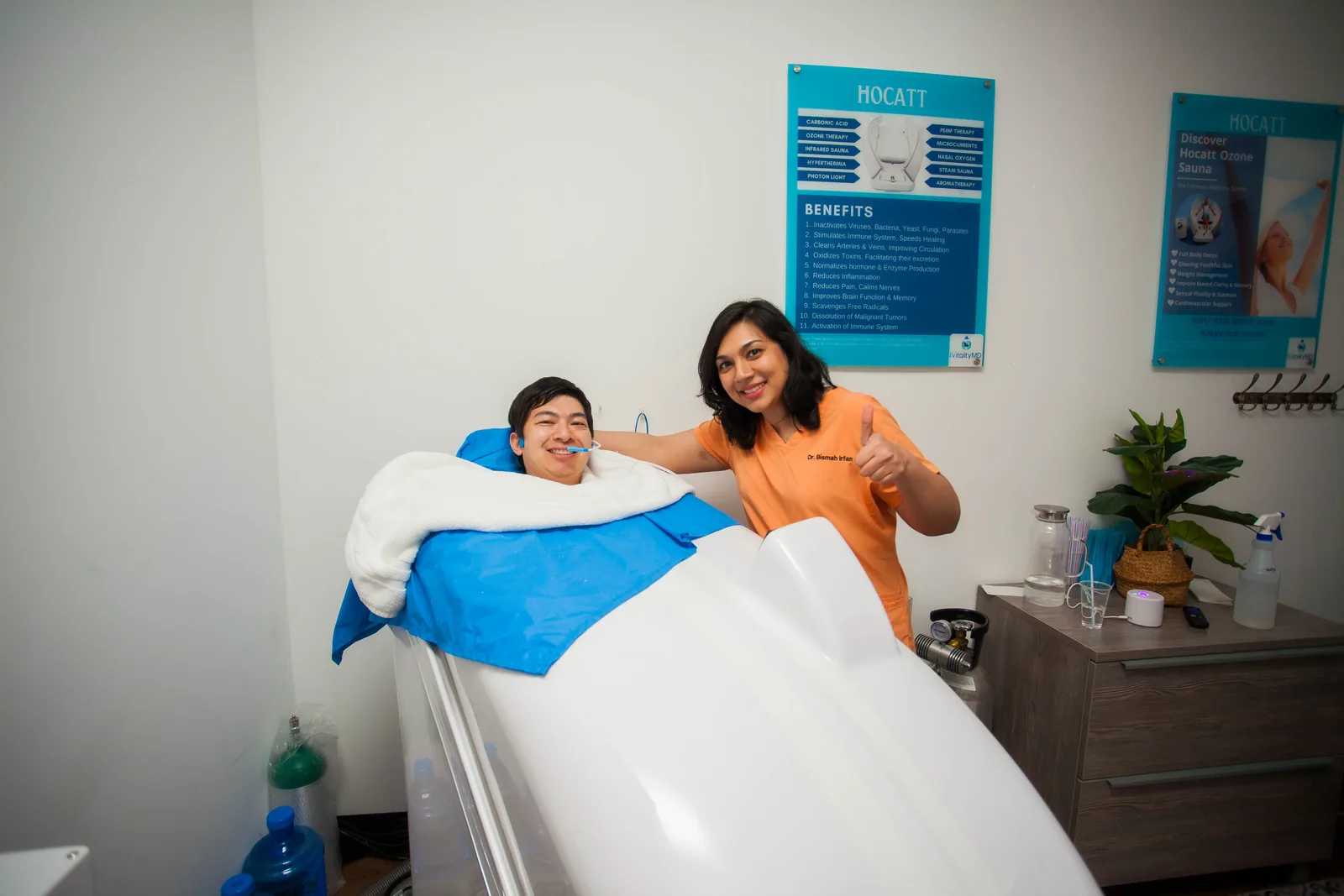
Patient during a HOCATT ozone sauna session at iVitality MD in Houston, with Dr. Bismah Irfan
A HOCATT session at our Houston clinic — Dr. Bismah checks in with every patient during treatment.

HOCATT Frequently Asked Questions

What is HOCATT therapy?

HOCATT (Hyperthermic Ozone and Carbonic Acid Transdermal Therapy) is a 30-minute single-person chamber session that delivers ten wellness therapies at once — ozone, carbonic acid, far-infrared heat, steam, pure oxygen, photon light, electrotherapy, vibration, aromatherapy, and a controlled cool-down. At iVitality MD in Houston, Dr. Bismah Irfan uses it as part of personalized protocols for chronic fatigue, detox support, autoimmune conditions, and longevity.

What does HOCATT therapy do?

Three things happen at once inside the chamber: steam and far-infrared heat raise your core temperature and open the skin, ozone and carbonic acid are absorbed transdermally, and you breathe pure oxygen the whole time. What you notice is a heavy sweat, a heart rate like light cardio, and a warm, alert feeling afterwards. Clinically we use it to support circulation, sweat-based detox pathways, and recovery capacity — as one piece of a plan, not as a treatment for any single disease.

How much does HOCATT cost?

HOCATT is a self-pay wellness service — commercial insurance plans in Texas do not cover it. iVitality MD offers single sessions, multi-session packages, and membership cadences; current pricing is shared during your consultation and our front desk will walk you through options. Patients with HSA or FSA accounts can typically use those funds toward sessions, and our team can provide the documentation you need to submit.

Will insurance or Medicare cover HOCATT?

No. Ozone therapy is not a covered benefit under commercial insurance plans in Texas, and Medicare does not reimburse it either, so no clinic can bill it on your behalf. HSA and FSA funds can usually be applied, and our team writes the documentation you need to submit. If a provider tells you they can get HOCATT covered by insurance, ask them to put that in writing before you pay.

How long is a HOCATT session?

A HOCATT session in the chamber is about 30 minutes — an eight-minute steam warm-up, twenty minutes of active ozone, CO2, and far-infrared, then a short cool-down. With check-in, changing, and a quick shower, plan for about 45 to 60 minutes total at the clinic. We recommend allowing 15 more minutes afterward to rest and rehydrate before driving.

How do you feel after a HOCATT session?

Most people step out warm, sweaty and noticeably relaxed — closer to how you feel after a long sauna than after a workout. Energy usually lifts within a few hours. After the first session or two, some patients feel briefly tired that evening instead; that is common and it passes. Plan on about fifteen minutes of rest and water before you drive, and expect to want a shower.

Is HOCATT safe? What are the contraindications?

HOCATT is well tolerated by most patients, including older adults. It is not appropriate during pregnancy, for people with active hyperthyroidism, severe cardiovascular disease, recent organ transplant, certain seizure disorders, or anyone unable to safely tolerate heat. Dr. Bismah Irfan screens every new patient against the full contraindication list before clearing them for a first session. If you have a complex medical history, the safest first step is a consultation.

What are the side effects of HOCATT?

Side effects are usually mild and short-lived. The most common are brief fatigue after the first one or two sessions, lightheadedness during the cool-down, a temporary increase in urination, and mild detox symptoms — a transient headache or muscle ache — that typically resolve within 24 hours. A fuller breakdown is in our article on HOCATT sauna side effects.

How often should I do HOCATT sessions?

It depends on what you are working through. For chronic illness or active detox protocols, most patients start with two to three sessions per week for four to six weeks, then shift to a maintenance cadence of one to two per month. For longevity, recovery, or general wellness, one session weekly or biweekly is enough for most people. Dr. Irfan adjusts your plan at the six-to-eight session mark based on response.

Does HOCATT help with chronic illness like Lyme, mold, or autoimmune conditions?

HOCATT is most often added to integrative protocols for chronic fatigue, post-viral fatigue, autoimmune presentations such as Hashimoto’s and rheumatoid conditions, Lyme disease, mold and biotoxin illness, post-COVID recovery, and long-term detox support. It is not a stand-alone cure for any disease, and it does not replace the diagnostic workup or medication management that goes into treating these conditions. Dr. Irfan layers it onto a broader, individualized plan.

Does HOCATT therapy actually work?

The device itself has not been through randomized controlled trials, and we do not claim otherwise. Its components have separate research behind them — medical ozone in mostly small European trials, sauna bathing in large observational cohorts, far-infrared heat and transdermal CO2 in small circulation studies — and none of that transfers cleanly to a combined 30-minute protocol. What we can report is clinical: patients tolerate it well and commonly describe steadier energy and better sleep across the first six to eight sessions. Dr. Irfan reassesses at that point using symptoms and labs, and drops the therapy if it is not earning its place in the plan.

What is the difference between HOCATT and EBOO?

HOCATT delivers ozone through the skin while you sit in a heated chamber. EBOO passes your blood through an external filter with ozone and oxygen and returns it to the other arm. HOCATT involves no needles and layers in heat, CO2, light and microcurrent; EBOO is an intravenous procedure with a narrower, blood-level target. Heat tolerance, IV access and what you are actually treating usually decide which one fits — the detail is on our page about EBOO therapy.