
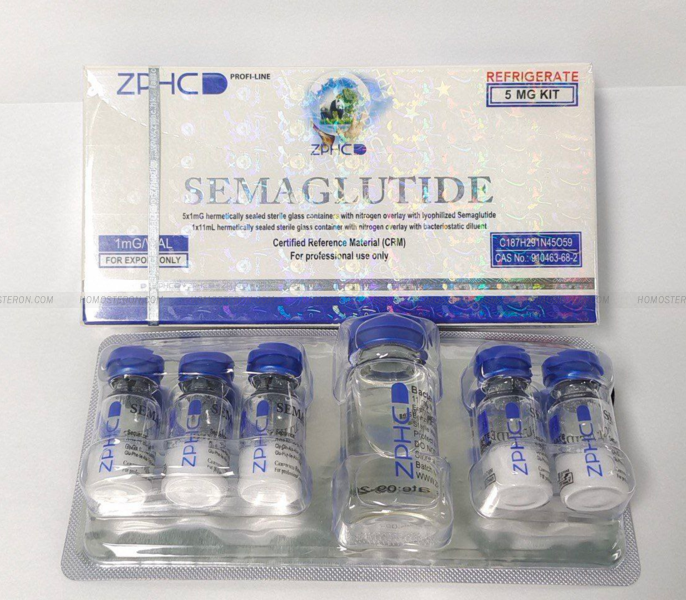
Direct answer: to reconstitute a 5 mg vial of semaglutide, mix in 5 ml of bacteriostatic water. This produces a final concentration of 1 mg per 1 ml, so every 0.10 ml drawn into a U-100 insulin syringe contains 0.10 mg of semaglutide. Below is the exact step-by-step procedure Dr. Bismah Irfan, MD walks her IVitality MD patients through, plus a reconstitution chart for every common vial strength (2–30 mg) and answers to the questions we hear most often.
How to Reconstitute 5 mg of Semaglutide: Step-by-Step Mixing Instructions
- Wash your hands and gather your equipment: a vial of 5 mg semaglutide powder, a vial of bacteriostatic water (0.9% benzyl alcohol), alcohol swabs, a sterile reconstitution syringe, and a sterile U-100 insulin syringe for dosing.
- Wipe both vial stoppers with an alcohol swab and let them air-dry for about 10 seconds.
- Draw 5 ml of bacteriostatic water into the reconstitution syringe.
- Inject the bacteriostatic water slowly into the semaglutide vial, aiming the stream against the inner glass wall — never directly at the powder. This prevents foaming and protects the peptide.
- Gently swirl the vial (do not shake) until the powder is fully dissolved and the solution is clear and colorless. The final concentration is 1 mg per ml.
- Label the vial with the reconstitution date and store it in the refrigerator at 36°F – 46°F (2 – 8°C). Use within 28 days.
Why the 5 ml Ratio Matters
Reconstitution is the step where dry semaglutide powder is dissolved into a sterile liquid you can actually inject. Using exactly 5 ml of bacteriostatic water with a 5 mg vial gives a clean 1 mg/ml concentration — that math makes dose calculation simple and consistent every time you draw a syringe. The benzyl alcohol in bacteriostatic water also suppresses bacterial growth, which is what allows the reconstituted vial to last 28 days in the fridge instead of 24 hours.
Need For Bacteriostatic Water
Semaglutide is shipped as a freeze-dried powder so that the peptide stays stable during transport and storage. Before injection, that powder must be dissolved into a liquid carrier — and bacteriostatic water is the standard choice because the 0.9% benzyl alcohol in it prevents microbial contamination during the multi-week dosing period. Sterile water and normal saline can technically dissolve the powder, but the reconstituted solution must then be used within 24 hours, which is impractical for a weekly injection regimen.
Proper Storage Required
Once reconstituted, store the vial in the refrigerator at 36°F – 46°F (2 – 8°C). Do not freeze. Keep the vial upright, away from light, and discard any solution that becomes cloudy, discolored, or develops particles. Reconstituted semaglutide is generally stable for up to 28 days when stored correctly. For more on the weekly dosing cadence after reconstitution, see our semaglutide dosing schedule guide.
Understand The Dosage Requirements
Your prescriber will set the exact starting dose and titration schedule based on your medical history, weight, and treatment goals. With a 1 mg/ml reconstituted vial, common starting doses translate directly to syringe markings: a 0.25 mg starting dose = 0.25 ml = 25 units on a U-100 insulin syringe. A 0.50 mg dose = 50 units. Always confirm the unit count with your prescriber before each injection — and rotate injection sites between the abdomen, the front of the thighs, and the back of the upper arms to avoid lipohypertrophy. Step-by-step injection technique is covered in our how to inject semaglutide guide.
Monitor Your Progress
Track your weekly weight, fasting blood glucose (if treating type 2 diabetes), and any side effects in a simple log. Bring this log to every follow-up — your prescriber will use the trend, not a single reading, to decide whether to hold the current dose or titrate up.
Semaglutide Reconstitution Chart: Ratios for All Common Doses (2–30 mg)
The 5 mg vial uses 5 ml of bacteriostatic water. For 2–15 mg vials the most common target is the same 1 mg/ml final concentration, which keeps the math at the syringe simple. 20 mg and 30 mg vials are usually supplied at a higher concentration, so for them the label on the vial sets the volume. The table below shows standard ratios for the dose strengths IVitality MD patients encounter most often, the resulting unit count on a U-100 insulin syringe, and a quick reference for typical starter doses.
| Vial strength | Bacteriostatic water | Final concentration | 0.25 mg dose | 0.50 mg dose | 1.0 mg dose |
|---|---|---|---|---|---|
| 2 mg | 2 ml | 1 mg/ml | 25 units | 50 units | — |
| 5 mg | 5 ml | 1 mg/ml | 25 units | 50 units | 100 units |
| 10 mg | 10 ml | 1 mg/ml | 25 units | 50 units | 100 units |
| 15 mg | 15 ml | 1 mg/ml | 25 units | 50 units | 100 units |
| 20 mg | per vial label | usually above 1 mg/ml | per label | per label | per label |
| 30 mg | per vial label | usually above 1 mg/ml | per label | per label | per label |
A practical note on the higher-strength vials: 20 mg and 30 mg compounded vials are sometimes supplied at a higher concentration (for example 3 mg/ml or 5 mg/ml) so the total liquid volume stays manageable. In those cases the unit math changes — a 0.25 mg dose at 3 mg/ml is about 8 units, not 25. The vial label and your prescriber’s reconstitution instructions override any generic chart, including this one. If the label shows a concentration other than 1 mg/ml, ask the prescriber to convert your prescribed dose into syringe units in writing before the first injection.
Reconstituting Retatrutide and Tirzepatide
Retatrutide and tirzepatide are different peptides from semaglutide, with different potencies and stability profiles. The reconstitution math is not interchangeable — using a semaglutide ratio on a tirzepatide vial would deliver several times the intended dose.
Compounded tirzepatide is most often supplied so that reconstitution produces a 5 mg/ml or 10 mg/ml working solution, not the 1 mg/ml semaglutide standard. A 25-unit draw of reconstituted semaglutide at 1 mg/ml is 0.25 mg; the same 25-unit draw of 5 mg/ml tirzepatide is 1.25 mg.
Retatrutide is an investigational triple-agonist that is not currently FDA-approved for clinical weight-loss use. It is not available by prescription, and the FDA has said it cannot be used in compounded medications, so we do not publish mixing instructions for it. Where its approval stands is covered in our guide to retatrutide and FDA approval. Two takeaways apply whenever you move between GLP-1 medications:
- Read the label on every vial. Compounded peptides ship with specific reconstitution instructions printed on the box or vial. Do not assume a 1 mg/ml ratio just because semaglutide uses one.
- Never carry dose habits across peptides. Confirm the math against the new label before injection, especially when switching between GLP-1 agonists under medical supervision.
U-100 vs U-40 vs U-50 Syringes — How Units Translate
Insulin syringes are calibrated to deliver a specific concentration of insulin per “unit” — and that calibration is what determines how much liquid each unit marking actually represents. A U-100 syringe is the standard in the United States: each unit equals 0.01 ml. When a 1 mg/ml semaglutide vial is drawn to 25 units on a U-100 syringe, that is 0.25 ml — a 0.25 mg dose.
U-40 syringes (more common in veterinary medicine and some European markets) deliver 0.025 ml per unit — two and a half times more liquid per marking. Drawing semaglutide to 25 units on a U-40 syringe would deliver 0.625 mg, not 0.25 mg. U-50 syringes sit between the two and are now rare in clinical use.
The practical rule: use a U-100 syringe for semaglutide, tirzepatide, and similar compounded peptides reconstituted at 1 mg/ml. If a pharmacy or compounding facility hands you a different syringe type, ask the prescriber to convert the dose to that syringe’s markings in writing before the first injection. The full breakdown is in our guide to reading insulin syringe units.
Common Reconstitution Mistakes (Clinical View)
Dr. Bismah Irfan, MD, sees the same handful of reconstitution errors repeatedly in her IVitality MD practice. Each one is avoidable with a careful read of the steps earlier in this guide.
- Shaking instead of swirling. Aggressive shaking introduces air bubbles and can denature the peptide. Gentle swirling — vial held upright, slow rotation in the palm — dissolves the powder without damaging it.
- Injecting bacteriostatic water directly onto the powder. The water stream should hit the inner glass wall, not the powder cake. A direct stream foams the peptide and can leave fragments undissolved.
- Using the wrong volume of bacteriostatic water. A 5 mg semaglutide vial gets 5 ml — not 1 ml, not 10 ml. A 1-ml dilution produces a 5 mg/ml solution that is five times the expected concentration; a 10-ml dilution halves it. Both errors lead to mis-dosing on every subsequent injection.
- Storing the reconstituted vial at room temperature. Reconstituted semaglutide belongs in the refrigerator at 36°F – 46°F (2 – 8°C). Room-temperature storage shortens the safe-use window from 28 days to roughly 24 hours.
- Reusing the reconstitution syringe for dosing. The large reconstitution syringe is for transferring water into the vial — it has no fine unit markings. Always switch to a fresh, sterile U-100 insulin syringe to draw each weekly dose.
- Skipping the alcohol swab on later doses. Every needle-puncture into the vial introduces contamination risk. Swab the stopper before the reconstitution syringe enters it, and again before each weekly dose draw.
If any of these mistakes happen and the solution looks cloudy, contains particles, or feels off, discard the vial and start fresh. Peptide is cheaper than treating a soft-tissue infection.
Wrapping Up
The short answer to “how much bacteriostatic water to mix with 5 mg of semaglutide” is 5 ml, giving a 1 mg/ml working concentration. Follow the six-step procedure above, store the reconstituted vial properly, and never deviate from the dose your prescriber set. If you’d like a personalized weight-loss plan reviewed by Dr. Bismah Irfan, MD, book a consultation with IVitality MD.
For patients also using mealtime insulin, see our comparison of Humalog vs Humulin — Humalog and Humulin R have different onset times and require different injection timing relative to meals.
Medically reviewed by Dr. Bismah Irfan, MD — Functional & Integrative Medicine, Houston, TX. Last reviewed: April 2026.
Frequently Asked Questions
How do you reconstitute 5 mg of semaglutide?
Draw 5 ml of bacteriostatic water into a sterile syringe and inject it slowly into the 5 mg vial, aiming the stream against the inner glass wall rather than directly at the powder. Swirl gently (never shake) until the solution is clear and colorless. The result is a 1 mg/ml concentration that stays stable for up to 28 days refrigerated.
How much bacteriostatic water do I mix with 10 mg of semaglutide?
The most common ratio is the same 1 mg per 1 ml as the 5 mg vial — that is, 10 ml of bacteriostatic water. Compounded semaglutide can be supplied at different concentrations, however, so always confirm the exact ratio printed on your vial label or in your prescriber's instructions before mixing.
Can I use normal saline instead of bacteriostatic water?
Normal (sterile) saline can reconstitute semaglutide, but it does not prevent bacterial growth. A saline-mixed vial must be used within 24 hours. Bacteriostatic water (0.9% benzyl alcohol) keeps the reconstituted solution stable for up to 28 days when refrigerated, which is what makes weekly injection schedules practical.
How long does reconstituted semaglutide last in the fridge?
When mixed with bacteriostatic water and stored at 36°F – 46°F (2 – 8°C), reconstituted semaglutide is generally stable for up to 28 days. Discard any remaining solution after that, even if the vial still has liquid in it.
Which syringe should I use to inject semaglutide?
A standard U-100 insulin syringe (1 ml or 0.5 ml capacity) works for the great majority of semaglutide doses. Each "unit" marking on the barrel corresponds to 0.01 ml — so 25 units = 0.25 ml.
How do I calculate my dose from a reconstituted vial?
With a 1 mg/ml concentration, every 0.10 ml on the syringe equals 0.10 mg of semaglutide. So a 0.25 mg dose = 0.25 ml = 25 units on a U-100 insulin syringe. A 0.50 mg dose = 0.50 ml = 50 units. Always double-check the unit count against your prescriber's instructions before injecting.
Where should I inject reconstituted semaglutide?
Subcutaneous injection in the abdomen (at least two inches away from the navel), the front of the thigh, or the back of the upper arm. Rotate sites with each weekly injection — repeating the same spot leads to lumps and uneven absorption.
What if my semaglutide solution looks cloudy after mixing?
A properly reconstituted vial is clear and colorless. If the solution stays cloudy, contains floating particles, or has changed color, discard the vial — do not inject. Cloudiness usually means the powder did not fully dissolve or the vial was contaminated.
How many doses can I get from a 5 mg semaglutide vial?
At a 1 mg/ml concentration, a 5 mg vial holds 5 ml, which is 500 units on a U-100 insulin syringe (100 units per ml). A patient on a 0.25 mg starter dose draws 25 units per week, so the vial covers about 20 weekly doses; at a 0.50 mg dose it is 50 units per week, about 10 doses. The 28-day refrigerator stability window is the practical limit, not the volume in the vial.
Can I mix retatrutide the same way as semaglutide?
No. Retatrutide is an investigational drug: it is not FDA-approved, is not available by prescription, and cannot be used in compounded medications, so there is no safe mixing ratio to follow. Tirzepatide, an approved medication, is usually supplied at a higher concentration than semaglutide, so its unit math is different too. Always follow the instructions on your vial and confirm syringe units with your prescriber before the first injection.
What if I added too much bacteriostatic water?
Adding more water than the label calls for dilutes the working concentration. For example, mixing 10 ml of bacteriostatic water into a 5 mg vial produces a 0.5 mg/ml solution — so a "25-unit dose" on a U-100 syringe now delivers only 0.125 mg, half the intended amount. Do not inject from a wrongly diluted vial; contact your prescriber for instructions on adjusted dosing or vial replacement. Adding less water than the label calls for is the opposite and more dangerous problem — it over-concentrates the solution and can cause an inadvertent overdose.
Getting the reconstitution and dose right matters, but it is only one piece of the picture. At iVitality MD, Dr. Bismah Irfan, MD oversees a medically supervised weight-loss program in Houston where your semaglutide dose, labs, and nutrition are managed for you — part of our wider peptide therapy care.
Book a Free Consultation