
NAD+ IV therapy can be worth trying for some adults as one part of a broader plan, but the evidence behind it is still early. The biology is real. NAD+ is essential for how cells make energy and repair DNA, and levels fall with age. Oral NAD+ precursors have been tested in clinical trials: they raise the level in your blood, and so far that hasn’t translated into feeling better. What we do not have yet are large, placebo-controlled trials showing that IV NAD+ improves energy, focus or healthy aging. If you go in knowing that, after a proper medical work-up and with realistic expectations, it can be a reasonable choice. If you are hoping it will end your exhaustion on its own, you will probably be disappointed.
Patients ask me about NAD+ a lot. Usually it comes up after a friend swears by it, or after a podcast host calls it the closest thing to a reset button. So here is how I explain it to patients in my Houston practice: what NAD+ does, what the studies show, what a drip feels like, and who should skip it.
What NAD+ is, in plain terms
NAD+ (nicotinamide adenine dinucleotide) is a coenzyme found in every cell. Your mitochondria need it to turn food into usable energy, and a group of repair and signaling enzymes, including PARPs and sirtuins, use it up as they work. Your body builds NAD+ from the vitamin B3 in food and from the amino acid tryptophan, and it recycles NAD+ constantly.
There is no free-floating “NAD+ tank” you can top up like fuel. NAD+ is made, used and broken down inside cells all day, and the level at any moment reflects that balance. Keep that in mind for later, when we get to what an infusion can and cannot do.
Does NAD+ really decline with age?
Yes, and this part of the story is well supported. In skin samples from people ranging from newborns to age 77, NAD+ levels fell steadily with age while markers of DNA damage rose (Massudi et al., PLoS One 2012). Blood measurements in adults aged 20 to 87 show a similar pattern, with lower plasma NAD+ in older people (Clement et al., Rejuvenation Res 2019). A major review in Nature Reviews Molecular Cell Biology lays out the likely reasons. DNA repair uses up more NAD+ as damage builds, NAD+-consuming enzymes such as CD38 become more active, and chronic low-grade inflammation adds to the drain (Covarrubias et al., 2021).
Where people go wrong is the jump from “NAD+ falls with age” to “putting NAD+ back will turn back aging.” The first has been measured. The second is still a hypothesis, and human trials are only starting to test it.
What the research shows, and where it stops
Most human data comes from two oral precursors, nicotinamide riboside (NR) and nicotinamide mononucleotide (NMN), because they are much easier to study than IV NAD+. Here is where that research stands.
Precursors raise NAD+ levels
In a randomized, placebo-controlled crossover trial in healthy middle-aged and older adults, six weeks of NR was well tolerated and raised NAD+ in blood cells (Martens et al., Nat Commun 2018). A 2023 review of the field reached the same conclusion: these compounds are safe, well tolerated and raise NAD+ in several tissues. The same review notes that whether this improves how the body actually works is still unclear (Freeberg et al., J Gerontol 2023).
Raising NAD+ does not reliably change how people feel
The results so far are mixed:
- In postmenopausal women with prediabetes and overweight or obesity, 10 weeks of NMN improved muscle insulin sensitivity (Yoshino et al., Science 2021).
- In obese, insulin-resistant men, 12 weeks of NR did not improve insulin sensitivity or other metabolic measures (Dollerup et al., Am J Clin Nutr 2018).
- In a 24-week randomized trial in long COVID, NR raised NAD+ levels two- to threefold but did not beat placebo for cognition, fatigue, sleep or mood (Wu et al., eClinicalMedicine 2025).
- A 2026 network meta-analysis of 27 studies found that no precursor significantly improved perceived fatigue or sleep quality, although NMN did improve measures of endurance (Gao et al., Front Nutr 2026).
- A meta-analysis of trials in older adults (average age over 60) found no support for NMN or NR in preserving muscle mass or physical function (Prokopidis et al., J Cachexia Sarcopenia Muscle 2025).
IV NAD+ itself has very little published research
The first study to track what happens to infused NAD+ in people was a small pilot published in 2019. During the first two hours of a slow, six-hour infusion, plasma NAD+ did not rise at all. The body cleared it from the blood as fast as it went in, most likely by breaking it down with enzymes or taking it up into tissues, and levels only began to climb after that (Grant et al., Front Aging Neurosci 2019). This tells us the body handles IV NAD+ actively. It does not tell us whether anyone ends up with more energy.
So when a patient asks me whether NAD+ IV is “proven,” my answer is no. It is biologically plausible, usually tolerable when the drip runs slowly, and supported by a growing body of precursor research. The benefits people describe are real experiences, but for IV NAD+ they have not yet been tested against a placebo.
IV, injections or capsules: how the routes compare
Patients often ask which form is “best.” Each one has trade-offs.
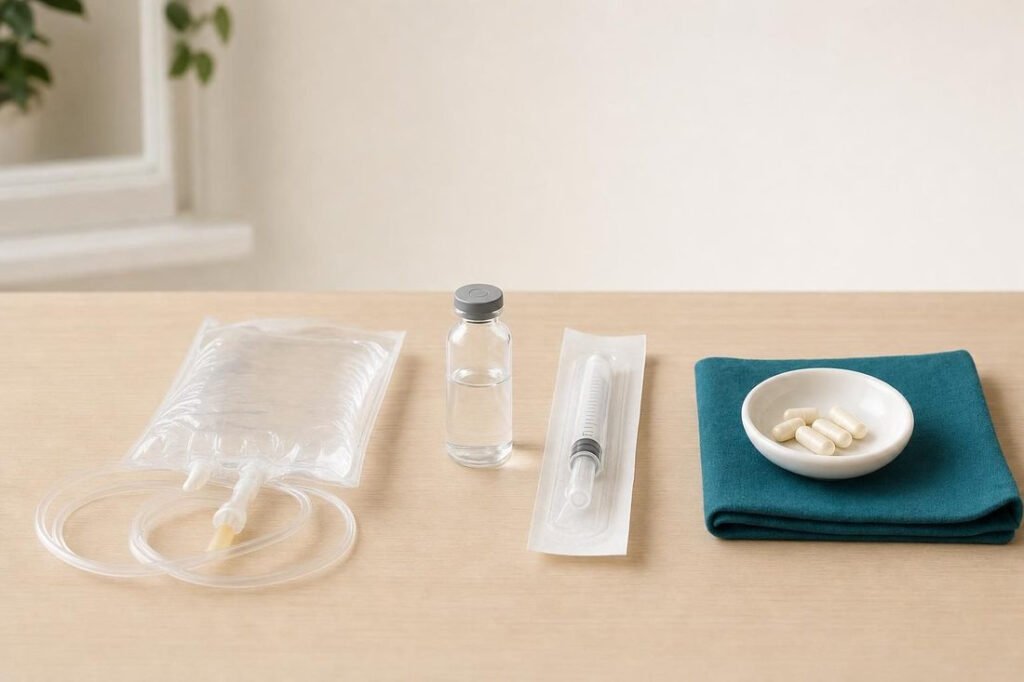
IV infusion. Delivers NAD+ straight into the bloodstream and bypasses digestion. It means a clinic visit, a slow drip and medical supervision. Formal research on this route is thin, and it causes the most side effects during the session.
Injections. Some clinics offer NAD+ as an intramuscular or subcutaneous shot. Injections are quicker, but published human data on them is even more limited, and the shot can sting.
Oral precursors (NR, NMN). Capsules taken daily. This is the best-studied route, with dozens of randomized trials, most of them small, showing that precursors are well tolerated and raise NAD+. The short version: they raise the level in your blood, and so far that hasn’t translated into feeling better. That is why I don’t suggest them to my patients as a fix for low energy.
For many people the sensible first step is none of these. Good sleep, regular exercise, and enough protein and B vitamins all support your body’s own NAD+ production, and the evidence that they help with energy is much stronger.
What an NAD+ drip feels like
NAD+ is not a comfortable infusion if it runs too fast. The most detailed real-world comparison so far looked at people who received 500 mg infusions of either NAD+ or NR on four consecutive days. People on NAD+ reported moderate to severe stomach and gut symptoms, a faster heart rate and chest pressure during the drip, which made their infusions longer: about 97 minutes on average, compared with 37 minutes for NR. All symptoms went away once the infusion ended. Over 30 days, standard liver enzymes, kidney function and an inflammation marker did not change, although HDL (“good”) cholesterol dipped in the NAD+ group, which the authors say needs more study (Reyna et al., Front Aging 2026). The study looked back at records from a commercial wellness chain and was run by that company’s own staff, so I treat it as useful practical information rather than proof of safety.
That matches what we see in clinic. Nausea, cramping, flushing or a tight feeling in the chest usually mean the drip is going too fast, and they ease when we slow it down. This is why an NAD+ session takes time, and why I want it given where someone medically trained is watching both the line and the patient.
Who should not get NAD+ IV, or should check with their doctor first
I would not start NAD+ IV, or would only consider it after a careful conversation, in these situations:
- Pregnancy or breastfeeding. IV NAD+ has not been studied in pregnancy, so there is no safety data.
- Active cancer or cancer treatment. Cancer cells depend heavily on NAD+ metabolism to keep dividing (Chiarugi et al., Nat Rev Cancer 2012). Whether extra NAD+ matters clinically is unknown, so this decision belongs with your oncologist.
- Heart disease or unexplained chest pain. Chest pressure is a common infusion effect, and it should never be confused with, or mask, a heart problem.
- Kidney disease: we usually hold NAD+ or avoid high doses, and decide case by case.
- Significant liver disease. The liver processes and clears NAD+ breakdown products, so dosing needs an individual review.
- Fatigue that has never been investigated. This is the one I care about most as an internist.
Persistent tiredness has many causes: thyroid disease, anemia or low iron, low B12, poorly controlled blood sugar, sleep apnea, depression, medication side effects, and sometimes kidney or heart problems. Some of these are serious, and most are very treatable. A drip that makes you feel a little better for a few days can delay finding the real cause. Certain common prescriptions also deplete nutrients that affect energy, which I cover in my article on medications and nutrient depletion.
When I think NAD+ IV is worth considering
For me, NAD+ is never the first step. We start with a history, an exam and labs that look for the common, fixable causes of low energy. If those are addressed and someone still wants support with energy, recovery or focus, NAD+ can be a reasonable addition. It tends to make the most sense for people who:
- are recovering from a long illness or a period of heavy stress, as part of a structured plan like our stress and burnout recovery program
- are already working on sleep, nutrition and movement, and want to see whether NAD+ adds anything on top
In my practice I use NAD+ most often alongside a recovery plan for alcohol or nicotine, for anxiety, and to support mitochondrial function. The published research here is still early, mostly small studies without a placebo group, so I treat it as one support within a broader plan, never as a substitute for addiction treatment or mental health care.
I ask patients to decide in advance what “working” would look like, such as fewer afternoon crashes or being able to exercise again, and to track it. If nothing changes after a short trial, we stop. That is a better use of your time and money than a standing schedule of drips that nobody is evaluating.
At iVitality MD, we give NAD+ as a slow, physician-supervised high-dose NAD+ infusion, or combined with glutathione in our NAD+ and glutathione drip. Our NAD+ is prepared by an FDA-registered outsourcing facility, or compounded by a licensed pharmacy for the individual patient when a higher or repeated dose is needed. If you are curious about glutathione itself, I have written a separate piece on what glutathione does and how to support it. Our other options are on the IV therapy in Houston page.
Questions to ask any clinic before you book
Wherever you go, these questions will tell you a lot:
- Who reviews my health history before the first infusion, and is a physician involved?
- Where does the NAD+ come from? It should come from an FDA-registered outsourcing facility or a licensed compounding pharmacy.
- How fast will it run, and what happens if I feel unwell during the drip?
- What will we measure or track to decide whether it is helping?
- Will you look for other causes of my symptoms first?
Clear, specific answers are a good sign. If the conversation keeps drifting back to packages and bundles, keep looking.
The way I think about it
The science on why NAD+ matters is strong. The human evidence for supplementing it is promising in places and disappointing in others, and the research on IV delivery is still thin. I am comfortable offering it to patients who understand that and who have had their fatigue properly worked up first. What I will not do is present it as a fix.
If you have been running on empty and want to understand why, that is where I would like to start with you. You can book a consultation at our clinic in West Houston, and we will go through your history and labs together before deciding whether NAD+ belongs in your plan. You can also read more about my background and approach.
Frequently Asked Questions
Is NAD+ IV therapy FDA approved?
No. NAD+ is not FDA-approved to treat any disease, and IV NAD+ is prepared by FDA-registered outsourcing facilities or compounding pharmacies for use under a clinician's supervision. That does not make it unsafe when given carefully, but it does mean the claims you see online have not gone through FDA review. Ask any clinic where its NAD+ comes from.
How quickly will I feel a difference after an NAD+ drip?
Some people say they feel clearer or more energetic within a day or two, and others notice nothing. No placebo-controlled trials of IV NAD+ have been published yet, so there is no reliable timeline. In my practice we agree in advance on what improvement would look like and reassess after a short series rather than continuing indefinitely.
Are NAD+ supplements as good as an IV?
Not in the way most people hope. Oral precursors such as nicotinamide riboside (NR) and nicotinamide mononucleotide (NMN) have been studied more than IV NAD+, and randomized trials show they are well tolerated. They raise the level in your blood, and so far that hasn't translated into feeling better: in trials on fatigue, sleep and mood they have mostly not beaten placebo. IV delivery bypasses digestion, but it has not been tested against a placebo either. I don't suggest NAD+ supplements to my patients as a fix for low energy. If you are tired, the first step is finding out why.
Is NAD+ the same as niacin or NADH?
No. Niacin (vitamin B3) is one of the raw materials your body uses to make NAD+, and high-dose niacin can cause strong flushing. NADH is the reduced form of NAD+ that carries electrons inside the cell, and it is sold as a separate supplement. NR and NMN are other precursors. They are related but behave differently in the body.
Can NAD+ IV therapy help with long COVID or chronic fatigue?
It is being studied, but the evidence is not there yet. In a 24-week randomized trial in long COVID, oral nicotinamide riboside raised NAD+ levels two- to threefold but did not improve fatigue, cognition, sleep or mood compared with placebo. Persistent fatigue deserves a full medical work-up for causes such as thyroid disease, anemia, sleep apnea or blood sugar problems before any IV therapy is considered.
References
- Massudi H, et al. Age-associated changes in oxidative stress and NAD+ metabolism in human tissue. PLoS One. 2012;7(7):e42357. PMID 22848760
- Clement J, et al. The plasma NAD+ metabolome is dysregulated in “normal” aging. Rejuvenation Res. 2019;22(2):121-130. PMID 30124109
- Covarrubias AJ, et al. NAD+ metabolism and its roles in cellular processes during ageing. Nat Rev Mol Cell Biol. 2021;22(2):119-141. PMID 33353981
- Martens CR, et al. Chronic nicotinamide riboside supplementation is well-tolerated and elevates NAD+ in healthy middle-aged and older adults. Nat Commun. 2018;9(1):1286. PMID 29599478
- Freeberg KA, et al. Dietary supplementation with NAD+-boosting compounds in humans: current knowledge and future directions. J Gerontol A Biol Sci Med Sci. 2023;78(12):2435-2448. PMID 37068054
- Yoshino M, et al. Nicotinamide mononucleotide increases muscle insulin sensitivity in prediabetic women. Science. 2021;372(6547):1224-1229. PMID 33888596
- Dollerup OL, et al. A randomized placebo-controlled clinical trial of nicotinamide riboside in obese men: safety, insulin-sensitivity, and lipid-mobilizing effects. Am J Clin Nutr. 2018;108(2):343-353. PMID 29992272
- Wu CY, et al. Effects of nicotinamide riboside on NAD+ levels, cognition, and symptom recovery in long-COVID: a randomized controlled trial. eClinicalMedicine. 2025;89:103633. PMID 41357333
- Gao Y, et al. Domain-specific effects of NAD+ precursors on fatigue and functional performance: a systematic review and network meta-analysis. Front Nutr. 2026;13:1890335. PMID 42774067
- Prokopidis K, et al. The effect of nicotinamide mononucleotide and riboside on skeletal muscle mass and function: a systematic review and meta-analysis. J Cachexia Sarcopenia Muscle. 2025;16(3):e13799. PMID 40275690
- Grant R, et al. A pilot study investigating changes in the human plasma and urine NAD+ metabolome during a 6 hour intravenous infusion of NAD+. Front Aging Neurosci. 2019;11:257. PMID 31572171
- Reyna K, et al. Intravenous infusion of nicotinamide adenine dinucleotide (NAD+) versus nicotinamide riboside (NR): a retrospective tolerability pilot study in a real-world setting. Front Aging. 2026;7:1652582. PMID 41704678
- Chiarugi A, et al. The NAD metabolome: a key determinant of cancer cell biology. Nat Rev Cancer. 2012;12(11):741-752. PMID 23018234
This article is for educational purposes and is not medical advice. NAD+ is not FDA-approved to treat any disease. Talk to your own physician before starting any IV therapy or supplement, especially if you are pregnant, have a chronic condition or take prescription medications.