Reviewed by Dr. Bismah Irfan, MD, board-certified in internal medicine and nephrology
Quick answer: no one can tell you a “research use only” peptide is safe, because no one has checked it for that. These vials are sold with a label that says they are not for humans, so nobody is responsible for whether the powder inside is the right molecule, the right amount or free of bacterial toxins. When researchers bought semaglutide vials from illegal online sellers and tested them, every sample carried bacterial endotoxin and none was close to the purity on the label. If you are curious about peptides, the safer route is a physician, a prescription and a licensed pharmacy, and even then some peptides still have very little human data behind them.
Already injecting something you bought online? Book a free consultation and bring the vial. No lecture, I promise.
Peptides went from a niche biohacking topic to something my patients’ coworkers talk about at lunch. A friend swears BPC-157 fixed his shoulder. A podcast guest walks through his “Wolverine stack.” A website sells a vial, a bottle of bacteriostatic water and a dosing calculator in one bundle, with “not for human consumption” printed in small letters at the bottom.
More people now come to their first visit already injecting something they ordered online. I understand why. The prices look low, the stories sound great, and it feels like a shortcut around a medical system that can be slow. So instead of telling you never to touch a peptide, let me show you what you are actually buying when you buy a “research peptide,” what has changed in 2026, and how to protect yourself.
What “research use only” actually means
A peptide is a short chain of amino acids that acts as a messenger in the body. Insulin is a peptide. So are semaglutide and tirzepatide. The word itself says nothing about safety; what matters is how a particular product was made and checked. (If you want the science of how peptides work, I cover it in peptide therapy explained.)
A medicine meant for injection has to meet standards for three things before it reaches you: identity (it is the molecule on the label), dose (the amount is what the label says) and sterility, which includes being free of the bacterial fragments called endotoxins. FDA-approved drugs and pharmacy-compounded drugs are made under rules that cover all three, and someone is accountable when they fail.
“Research use only” products sit outside that system on purpose. The label tells regulators the seller is not making a drug for people, so the seller does not have to prove anything a drug maker would. In practice, the same websites publish dosing charts, reconstitution guides and before-and-after stories. Everyone involved knows where the vial is going.
The FDA has stopped accepting the label as a shield. Starting with letters dated March 31, 2026, and in further rounds in June and August, the agency sent warning letters to online peptide sellers stating that their products are unapproved new drugs. In an August letter to one of these sellers, the FDA noted that the company sold bacteriostatic water alongside its peptides, and said that pairing showed the water was meant for injection too (FDA warning letter, Aug 24, 2026). The products named across these letters included semaglutide, tirzepatide, retatrutide, tesamorelin and PT-141.
What lab tests have found in online vials
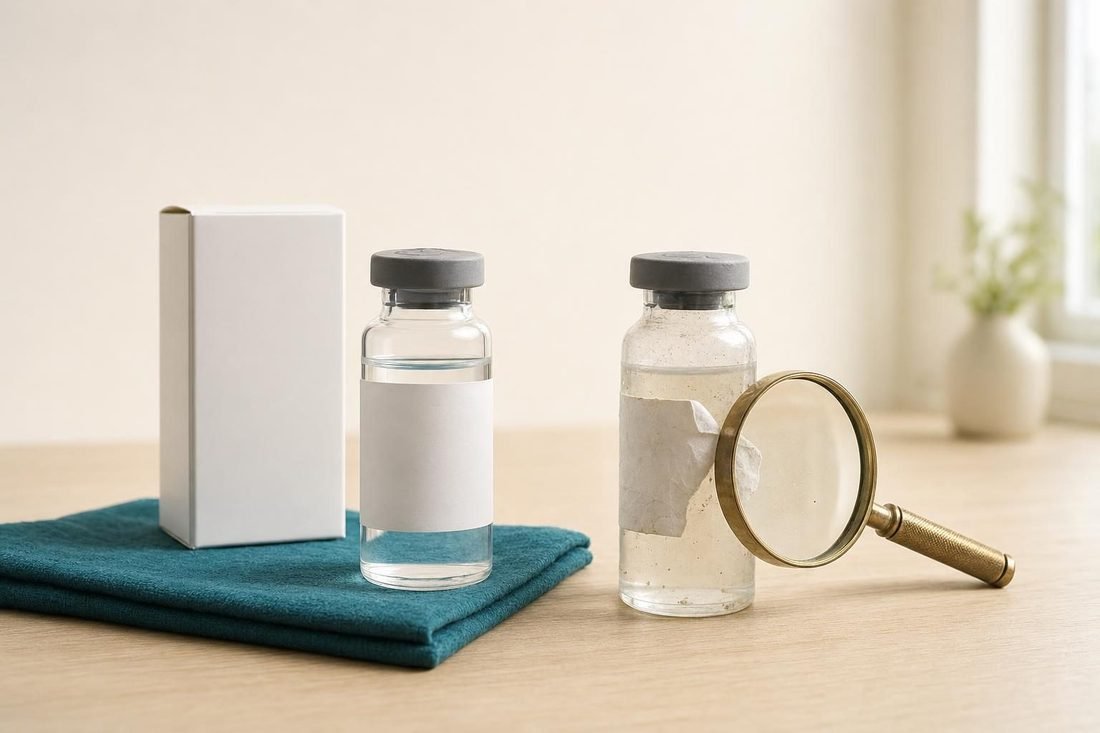
We don’t have to guess about quality. A research team bought semaglutide from illegal online pharmacies without a prescription and ran the vials through a lab (Ashraf et al., J Med Internet Res, 2024). Here is what they found:
- Purity of 7.7% to 14.4%, against the 99% printed on the labels.
- Endotoxin in every sample. No live bacteria grew, but the fragments of bacterial cell walls were there.
- More drug than the label said, by 29% to 39%. With a medicine whose side effects rise with the dose, that is not a bonus.
- Half the orders never arrived at all. The prefilled pens were simple scams.
Endotoxin deserves a sentence of explanation, because “sterile” and “safe to inject” are not the same thing. Endotoxins are pieces of the outer wall of certain bacteria, left behind even after the bacteria are dead, and the FDA notes they are not removed by sterilizing filters (FDA, bacterial endotoxins). Injected, they can cause fever and chills, and larger amounts can set off a much more serious inflammatory reaction. That is why injectable drugs are tested batch by batch for them.
That study looked at semaglutide, a well-known drug with a reference standard. BPC-157, TB-500, CJC-1295 and similar compounds come through the same online channels, usually with even less to compare against. When I ask patients what certificate of analysis came with their vial, the honest answer is usually “a PDF on the website.”
Where the law stands right now (November 2026)
Peptide headlines this year have been confusing, so here is the plain version as of this writing.
FDA-approved peptides have been through full human trials for a specific use. Examples include insulin, semaglutide (Ozempic, Wegovy), tirzepatide (Mounjaro, Zepbound), tesamorelin (Egrifta) and bremelanotide (Vyleesi, which is PT-141). A “research” vial with the same name is not the approved product. It is a powder from an unknown factory.
Compounded peptides are made by a licensed pharmacy for a named patient on a prescription. A pharmacy can only compound from ingredients the law allows, and the list of allowed ingredients is where most of 2026’s news happened.
BPC-157. In April 2026 the FDA removed BPC-157 and eleven other peptides from its list of compounding ingredients with significant safety concerns, after the companies that nominated them withdrew. That removal did not make them legal to compound; it took them out of one category without putting them on the approved list (FDA, bulk drug substances page). On July 23, 2026, an FDA advisory committee voted 8 to 6 to recommend adding BPC-157 to that list. The vote is not binding. The FDA has to write and finalize a rule first, and FDA staff scientists told the committee that quality human data on safety and effectiveness are lacking (ABC News, July 23, 2026).
CJC-1295 and ipamorelin, a popular pair for “growth hormone support,” were not part of that April change. On the same FDA page, the agency lists serious adverse events reported with CJC-1295, including increased heart rate, and serious adverse events, including death, when ipamorelin was given intravenously in a published study.
Retatrutide is still in clinical trials and is not FDA-approved. Anything sold as retatrutide today is, by definition, not the drug being tested in those trials. I explain the trial picture in retatrutide: what it is and whether it is FDA approved.
I am a physician, not a lawyer, and the rules may shift again in the coming months. The practical point won’t change, though: a website calling something “legal now” is not the same as a pharmacy being allowed to make it for you.
A prescription is not the whole answer
In October 2026, a coroner in Australia released findings on the death of a man who had been prescribed CJC-1295 and ipamorelin, made by a licensed compounding pharmacy. He had signed a consent form that listed anaphylaxis as a risk. Shortly before he died, he told a nurse he had been injecting double the prescribed dose. According to the findings, the injection caused anaphylaxis, a severe allergic reaction, which led to cardiac arrest; he also had asthma and a heart muscle condition. The coroner asked Australia’s medicines regulator to review these peptides and consider limiting them to clinical trials.
I bring this up because it shows something easy to miss. A cleaner vial from a real pharmacy removes one big risk, the unknown powder. It does not answer the second question, which is whether the molecule itself is safe for you, at that dose, with your health history.
For most peptides people are injecting, the human evidence is thin. BPC-157 has a handful of small pilot studies with no control group; the intravenous safety study included two people (Lee and Burgess, 2025). A 2026 review of peptides used in sports medicine concluded that rigorous human safety data are scarce and that there is potential for serious harm (Mendias and Awan, Sports Med, 2026). Any injected peptide can also train the immune system to react to it, which is why allergic reactions and antibodies come up again and again in the FDA’s reviews.
A Stanford pathologist put it in one line I keep repeating to patients: “If a person takes them and they feel fine, that doesn’t mean that they are fine long term” (Stanford Medicine, Aug 2026).
If you are already injecting something you bought online

Please don’t just quietly keep going, and please don’t hide it from your doctors. Here is what I ask patients to do:
- Bring the vial, the box and the website name to your next visit, or take clear photos of the label and lot number.
- Write down exactly what you take: which product, how you mix it, how many units, how often and since when. Mixing errors are common, and a “small” dose can easily be ten times what you think.
- Stop and call if you get fever, chills, a hot, red or swollen injection site, a rash, a racing heart, or new headaches or dizziness.
- Go to the emergency room or call 911 for trouble breathing, swelling of the lips, tongue or throat, chest pain or fainting. These can be signs of anaphylaxis, and minutes matter.
- Never share vials or needles, and don’t stack several unknown compounds at once. If something goes wrong, nobody will be able to tell which one caused it.
- Tell every doctor who treats you, especially before surgery or anesthesia, during pregnancy planning, or if you have heart, kidney or liver disease. As a kidney specialist, I also want to know because kidney function changes how the body handles many injected drugs, and several of these products affect blood sugar, heart rate or fluid balance.
- Ask for baseline labs. A metabolic panel, blood count and, depending on the product, blood sugar, A1c, IGF-1 or thyroid tests give you and your doctor a reference point.
One more thing that comes up with BPC-157 specifically: in some people it seems to aggravate histamine or mast-cell symptoms such as flushing, hives or itching. If that is you, tell your doctor rather than pushing through.
Questions to ask any clinic before you start a peptide
A good clinic will be glad you asked these. A clinic that gets defensive has answered them for you.
- Is this peptide FDA-approved for what I want to use it for? If not, what human evidence is there?
- If it is compounded, which pharmacy makes it? Is it a state-licensed 503A pharmacy or an FDA-registered 503B outsourcing facility?
- Is this ingredient currently allowed in compounding, today, not “soon”?
- Will the vial come with a pharmacy label that has my name, a lot number and an expiration date?
- What labs do you want before I start and while I’m on it?
- What side effects should make me call you, and who answers after hours?
- What result are we aiming for, and when do we stop if it isn’t working?
And the red flags: no exam or labs, “research grade” in the description, a bundle with water and a dosing calculator, payment only by crypto or gift card, and before-and-after photos that promise a result.
How I approach peptides at iVitality
When a patient asks me about a peptide, I start where I start with everything: what is going on, what the labs show, and what the root cause might be. Sleep, nutrition, inflammation, hormones and metabolic health come first. Peptides are never step one, and they never replace that work.
If a peptide does make sense, I use FDA-approved options where they exist, such as prescription semaglutide for weight and metabolic health. A compounded product should only ever be prescribed after an exam and labs, and it should come from a licensed U.S. pharmacy with a patient-specific label. We agree in advance on the goal and on what will make us stop. And quite often, after we have gone through the evidence together, the honest answer is “not yet.”
If you would like to talk through a peptide you are considering, or one you are already using, you can book a free consultation with our team in Houston. You can also read more about peptide therapy at iVitality and about me.
Frequently Asked Questions
Is it illegal to buy research peptides?
The FDA's 2026 enforcement has been aimed at the companies selling them, which it says are distributing unapproved drugs. I can't give legal advice, and the law depends on the product and the state. The medical answer is simpler: buying them means injecting something nobody has checked for human use.
Is BPC-157 legal now?
Not for compounding yet. In July 2026 an FDA advisory committee voted 8 to 6 to recommend allowing it, but the FDA still has to issue a rule. BPC-157 is not FDA-approved for any use, and the human evidence comes from a few very small studies.
Are collagen peptides the same as injectable peptides?
No. Collagen peptides are a food supplement you swallow; digestion breaks them down like other protein. Injectable peptides bypass digestion and act as signaling molecules, which is exactly why quality and dosing matter so much more for them.
Which peptides are FDA-approved?
Many, including insulin, semaglutide, tirzepatide, liraglutide, tesamorelin and bremelanotide, each for specific conditions. Approval is for the brand-name or pharmacy-dispensed product, never for a "research" vial that shares its name.
Can I get peptide therapy from a doctor in Houston?
Yes. At iVitality MD we start with a consultation, history and labs, and discuss whether any peptide fits your situation and which source we would use. Book a free consultation.
This article is for general education and is not medical or legal advice. Most peptides discussed here are not FDA-approved, and their regulatory status may change. Do not start, stop or change any medication or peptide without talking to a qualified physician.