
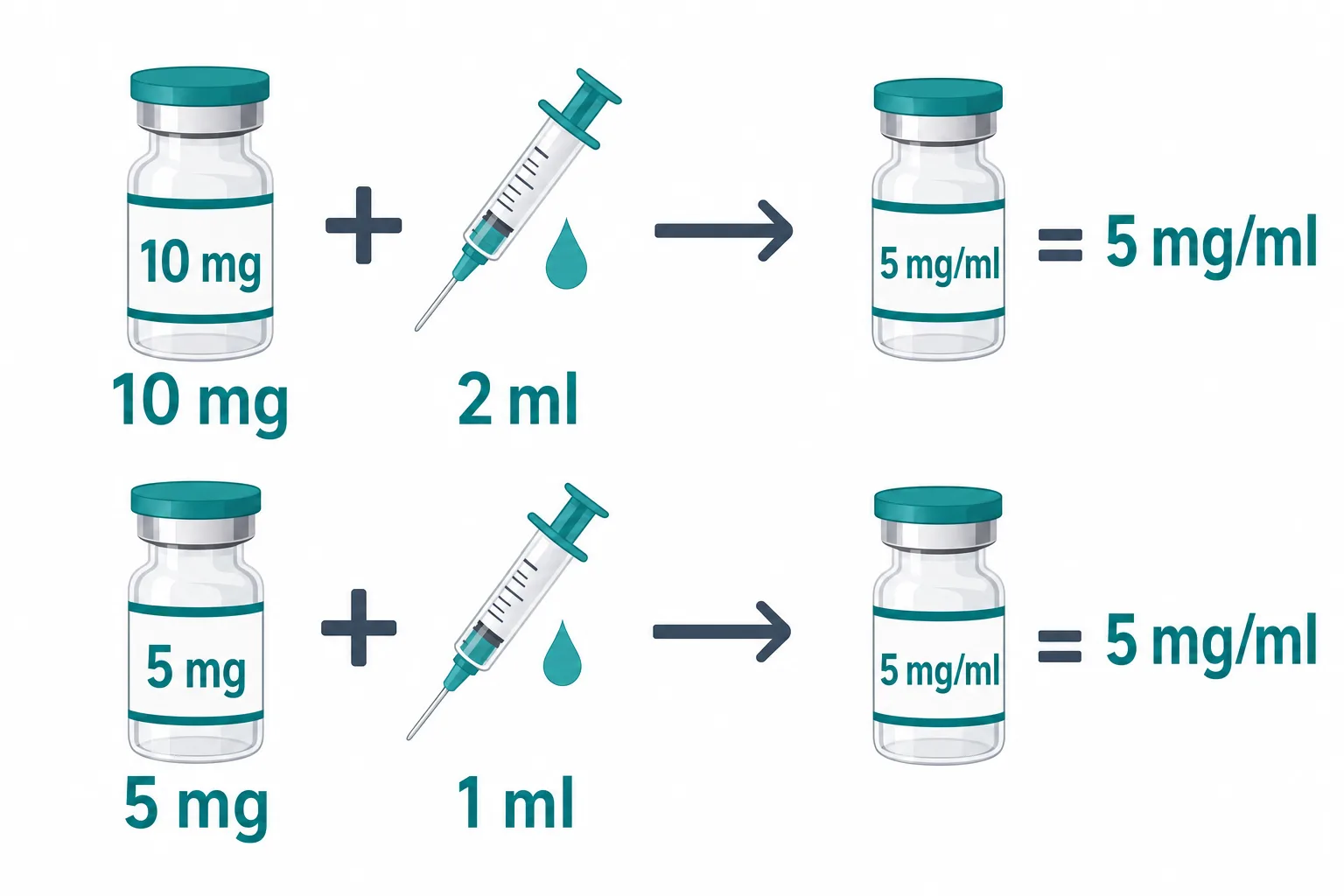
Direct answer: there is no official ratio, because retatrutide is still an investigational drug with no FDA-approved label. In the compounded and research-peptide protocols we see most often, a 10 mg vial is mixed with 2 ml of bacteriostatic water for a 5 mg/ml solution, and a 5 mg vial with 1 ml for the same 5 mg/ml concentration. The full reconstitution chart for both vial sizes — with syringe unit counts for every common dose — is below, along with the safety rails Dr. Bismah Irfan, MD asks every patient to follow before touching a vial: the label on your specific vial and your prescriber’s written instructions always override any generic chart, including this one.
First, the Status: Retatrutide Is Not FDA-Approved (July 2026)
Retatrutide is Eli Lilly’s triple-agonist peptide — it acts on GLP-1, GIP, and glucagon receptors at the same time, which is one receptor more than tirzepatide and two more than semaglutide. Phase 3 trials have reported average weight loss in the range of a quarter of total body weight at the highest doses, which explains the surge of interest. As of July 2026, however, it remains investigational: Lilly’s application to the FDA is still ahead, and approval is not expected before late 2027. Anything sold as “retatrutide” today comes from research-chemical suppliers or compounding channels that operate outside the approval process, with no manufacturing oversight — vial strength and purity are whatever the seller claims. We cover the regulatory picture in detail in what retatrutide is and whether it’s FDA-approved and whether retatrutide is available in the US.
That context is not a formality. It is the reason this guide keeps repeating the same instruction: confirm the concentration and the dose math with a qualified prescriber before the first injection.
Retatrutide Reconstitution Chart: 5 mg and 10 mg Vials
The mixing technique is identical to semaglutide — bacteriostatic water, slow stream against the glass wall, gentle swirl. What changes is the math. Semaglutide is conventionally reconstituted to 1 mg/ml; retatrutide doses are several times higher, so protocols use more concentrated solutions, most often 5 mg/ml or 10 mg/ml, to keep injection volumes small.
| Vial strength | Bacteriostatic water | Final concentration | 1 unit on a U-100 syringe = |
|---|---|---|---|
| 5 mg | 1 ml | 5 mg/ml | 0.05 mg |
| 5 mg | 2 ml | 2.5 mg/ml | 0.025 mg |
| 10 mg | 1 ml | 10 mg/ml | 0.10 mg |
| 10 mg | 2 ml | 5 mg/ml | 0.05 mg |
| 10 mg | 4 ml | 2.5 mg/ml | 0.025 mg |
And the syringe-unit side of the chart — how many units on a standard U-100 insulin syringe correspond to each dose:
| Dose | At 2.5 mg/ml | At 5 mg/ml | At 10 mg/ml |
|---|---|---|---|
| 1 mg | 40 units | 20 units | 10 units |
| 2 mg | 80 units | 40 units | 20 units |
| 4 mg | 160 units* | 80 units | 40 units |
| 8 mg | — | 160 units* | 80 units |
| 12 mg | — | — | 120 units* |
Step-by-Step Mixing Procedure
- Wash your hands and gather the equipment: the retatrutide vial, bacteriostatic water (0.9% benzyl alcohol), alcohol swabs, a sterile reconstitution syringe, and a fresh U-100 insulin syringe for dosing.
- Swab both vial stoppers and let them air-dry for about ten seconds.
- Draw the planned volume of bacteriostatic water — the volume you chose from the chart above, matched to your prescriber’s instructions.
- Inject the water slowly against the inner glass wall of the retatrutide vial, never straight onto the powder, to avoid foaming.
- Swirl gently until fully dissolved. The solution should be clear and colorless. Do not shake.
- Label the vial with the date and the final concentration in mg/ml — with retatrutide this step matters even more than with semaglutide, because there is no standard concentration and a mislabeled vial is how dosing errors happen. Refrigerate at 36–46°F (2–8°C).
The technique is covered with photos in our semaglutide reconstitution guide — the hand skills transfer one-to-one; the numbers do not.
Why You Cannot Reuse Semaglutide Math
This is the mistake we warn about most. A 25-unit draw of semaglutide at the standard 1 mg/ml is 0.25 mg. The same 25-unit draw of retatrutide at 5 mg/ml is 1.25 mg, and at 10 mg/ml it is 2.5 mg — ten times the semaglutide dose from the same syringe marking. If you previously used semaglutide or tirzepatide, treat retatrutide as a blank slate: recalculate from the label, write the unit count down, and have your prescriber confirm it before the first injection.
What Doses Were Actually Studied
In Lilly’s clinical trials, weekly retatrutide doses ranged from 1 mg up to 12 mg, and participants did not start high: protocols began at low doses and escalated stepwise over many weeks to manage nausea and other gastrointestinal effects. The published trial results — including the widely quoted weight-loss percentages — describe those supervised, gradually titrated regimens, not a fixed weekly amount someone picks from a chart. If a prescriber has put you on a retatrutide protocol, the titration schedule is theirs to set; if no prescriber is involved, that absence is the problem to solve first, and our team is happy to be that second opinion.
The Syringe-Capacity Catch
A standard U-100 insulin syringe holds 1 ml — 100 units. Look at the second chart again: an 8 mg dose at 5 mg/ml is 160 units, which physically does not fit. This is exactly why higher-dose protocols use the 10 mg/ml concentration, and it is a useful sanity check in reverse: if your calculated dose exceeds 100 units, either the concentration is wrong for your dose, or the math is. Stop and re-check the label rather than splitting the dose into two injections on your own initiative — dose-splitting decisions belong to the prescriber.
Storage After Reconstitution
Once mixed with bacteriostatic water, keep the vial refrigerated at 36–46°F (2–8°C), upright and away from light. The 28-day use window commonly cited for bacteriostatic-water reconstitution is a general peptide convention, not a tested retatrutide specification — some supplier protocols state shorter windows, and the conservative move is to follow the most cautious instruction you have. Discard the vial if the solution turns cloudy, changes color, or develops particles, regardless of the calendar.
Common Retatrutide Mixing Mistakes
- Assuming 1 mg/ml because semaglutide uses it. Retatrutide protocols run 2.5–10 mg/ml. The concentration on your label decides everything downstream.
- Not writing the concentration on the vial. Two weeks later, “was this the 1 ml or the 2 ml dilution?” is not a question you want to answer from memory.
- Carrying unit counts across peptides or across vials. Every new vial gets fresh math against its own label.
- Shaking instead of swirling, or firing the water jet straight onto the powder — both can damage the peptide.
- Trusting an unverified vial. Research-chemical retatrutide has no independent quality control. Underdosed vials are a financial problem; overdosed or contaminated ones are a medical one.
The Bottom Line
The honest answer to “how much bacteriostatic water to mix with retatrutide” is: the volume that produces the concentration your prescriber specified — most commonly 1 ml into a 5 mg vial or 2 ml into a 10 mg vial for 5 mg/ml. The chart above covers the standard variations, and the label on your vial outranks all of them. Retatrutide’s trial results are genuinely impressive, and it is still an unapproved compound best handled with a physician in the loop. If you want GLP-1 weight loss that is available and supervised today, book a consultation with IVitality MD — our medical weight-loss program builds the protocol around your labs, and injection technique itself is covered in our step-by-step injection guide.
Medically reviewed by Dr. Bismah Irfan, MD — Functional & Integrative Medicine, Houston, TX. Last reviewed: July 2026.
Frequently Asked Questions
How much bacteriostatic water do I mix with 10 mg of retatrutide?
Most compounded and research protocols mix a 10 mg vial with 2 ml of bacteriostatic water for a 5 mg/ml solution, or 1 ml for 10 mg/ml. There is no official standard because retatrutide is not FDA-approved — the label on your vial and your prescriber's written instructions override any generic ratio.
Is retatrutide FDA approved?
No. As of July 2026 retatrutide remains investigational. Eli Lilly's phase 3 trials have reported strong weight-loss results, but the FDA application is still ahead and approval is not expected before late 2027.
Can I use the semaglutide 1 mg/ml ratio for retatrutide?
No. Retatrutide protocols typically run at 2.5–10 mg/ml, so the same syringe marking can deliver up to ten times more medication than it would with semaglutide. Recalculate from your vial's label and have a prescriber confirm the unit count before the first injection.
How long does reconstituted retatrutide last in the refrigerator?
The 28-day window at 36–46°F (2–8°C) commonly cited for bacteriostatic-water reconstitution is a general peptide convention, not a tested retatrutide specification. Follow the most cautious instruction that came with your vial, and discard the solution if it turns cloudy, changes color, or develops particles.