
Reviewed by Dr. Bismah Irfan, MD — June 2026
Something happens inside a woman’s body during the years around menopause that medicine has dramatically underestimated. Not just the hot flashes and the disrupted sleep — those at least get talked about. I mean something deeper, happening quietly inside the blood vessels, the heart, and the kidneys. A slow, progressive shift in the systems that control blood pressure, inflammation, and fluid balance.
Here is what makes it so striking. For her entire reproductive life, a woman is naturally, measurably protected against high blood pressure. Her risk is lower than a man the same age. Her blood vessels are more relaxed, her kidneys handle salt and fluid in a more balanced way, and her heart carries less strain. This pattern is consistent across populations and decades of research, and after menopause the gap narrows: blood pressure tends to rise, and women become more sensitive to dietary salt (Mayo Clinic).
We have known for years that estrogen was central to that protection. What is newer is a clearer mechanistic picture of how estrogen was acting — helped along by a 2026 computational modeling study from the University of Waterloo (uwaterloo.ca) and the broader review literature on estrogen and the cardiovascular-renal system. I’ll flag where something is a model prediction versus an established finding, because that distinction matters.
“From a cardiovascular and kidney standpoint, the menopausal transition has effects we tend to under-recognize — and they’re worth paying attention to early.” — Dr. Bismah Irfan
Your Body’s Master Pressure System
To understand what estrogen was doing, you first have to understand the system it was managing: the renin-angiotensin-aldosterone system, or RAAS. It is your body’s master regulator of blood pressure.
The simplest way I’ve found to explain it is this. Think of the RAAS as a fire alarm for low blood pressure. When your pressure drops — say you’re dehydrated or you stand up too fast — your kidneys sense it and pull the alarm. That alarm squeezes your blood vessels tighter and tells your kidneys to hold on to more salt and water. In an emergency, this system is life-saving. The problem comes when it gets stuck in alarm mode permanently.
Here is the part most people never hear: the RAAS doesn’t have just one alarm. It has two sides.
- The aggressive side constricts blood vessels, drives sodium retention, and is pro-inflammatory. Chronically over-activated, it wears down the heart, kidneys, and blood vessels over time.
- The calming side does the opposite — it relaxes vessels, reduces inflammation, helps the kidneys release sodium instead of holding it, and supports healthy filtration pressure.
Picture a seesaw with two teams. One team squeezes everything tight and holds salt; the other relaxes everything and releases sodium. A healthy cardiovascular system is one where those two teams stay in dynamic balance. And for decades, estrogen was the referee keeping that seesaw level.
What Estrogen Was Quietly Doing — Every Day, for Decades
Estrogen wasn’t just making women feel better. It was actively managing that balance, all day, every day. On the aggressive side, it quieted the enzymes and receptors that drive constriction. On the calming side, it amplified the protective arm and boosted nitric oxide, the molecule that keeps vessel walls relaxed and responsive. It also reduced sodium retention and dampened the body’s stress-response arm. Broadly, the review literature describes estrogen as raising angiotensinogen while lowering renin, ACE activity, AT1-receptor density, and aldosterone (O’Donnell et al., review).
There’s one detail that tends to confuse people, so let me address it directly. Estrogen actually increases the raw material the whole system is built from — which sounds like it should raise blood pressure. But it simultaneously blocks so many of the downstream steps that the net effect is a quieter, more balanced system. Imagine a fully stocked kitchen where all the appliances are locked: plenty of raw material, but the machinery to process it is restrained. After menopause, the appliances get unlocked. The raw material is still there, and now it moves through the whole chain unchecked. That’s when pressure starts to climb.
Why Perimenopause Is Its Own Risk Phase
This is where I want to slow down, because perimenopause gets treated like a waiting room — some fluctuating hormones, a few irregular cycles, maybe early hot flashes. Manage the symptoms and wait for it to be over.
But from a cardiovascular and kidney standpoint, perimenopause is its own risk phase. As estrogen fluctuates and progressively falls over a window that can span several years, that protective influence is steadily withdrawn. Each drop nudges the system a little further toward the aggressive, pro-inflammatory state. It isn’t a cliff edge — it’s a slope, and the slope begins here.
Here is what’s clinically frustrating: this often looks unremarkable on a standard checkup.
- A blood pressure of 128/82 gets noted but not acted on.
- A creatinine that moved from 0.7 to 0.9 over two years is still technically “normal.”
- Inflammatory markers begin trending up, but no single number sets off an alarm.
In a woman whose referee is progressively leaving the field, these are signals — and they deserve attention, not just monitoring. The early window is exactly where you have the most power to change the trajectory.
It’s Not Just Blood Pressure
What surprises people most is how connected the downstream consequences are. The same shift that drives blood pressure up is also involved in cardiac muscle stiffening, the progression of atherosclerosis, decline in kidney filtration, and even accelerated bone mineral density loss after menopause.
In conventional care, we often treat each of these in a separate clinic with a separate specialist — the cardiologist, the nephrologist, the endocrinologist — without connecting them to the shared hormonal change underneath. A recurring theme in the review literature is that estrogen loss leaves this system tilted toward its pro-inflammatory side, which may contribute to several conditions that tend to cluster after menopause.
That framing is useful because a shared contributor can mean shared leverage — you may be looking at one system rather than four unrelated problems.
One Finding, Carefully Stated
Here is where I have to be precise, because it’s easy to overstate. The Waterloo paper is a mathematical model, not a clinical trial. When the researchers simulated different blood-pressure medications across a woman’s lifespan, the model predicted that ARBs (angiotensin receptor blockers) would be more effective than ACE inhibitors in women with hypertension, even after estrogen declines (University of Waterloo). The authors themselves frame this as a model prediction and note that no model is perfect.
So to be completely clear: this is not a guideline, and it is not a reason to change or stop a medication on your own. Both drug classes have well-established uses, and the right choice is individual. The reasonable takeaway is narrower — if you’re managing blood pressure after menopause, it can be worth asking your own physician whether your treatment fits your situation. That decision stays between you and your prescriber.
Everyday Factors Worth Addressing
From a functional-medicine standpoint, understanding the estrogen-RAAS connection points to several practical factors worth looking at. None of these replace medical management — they sit alongside it.
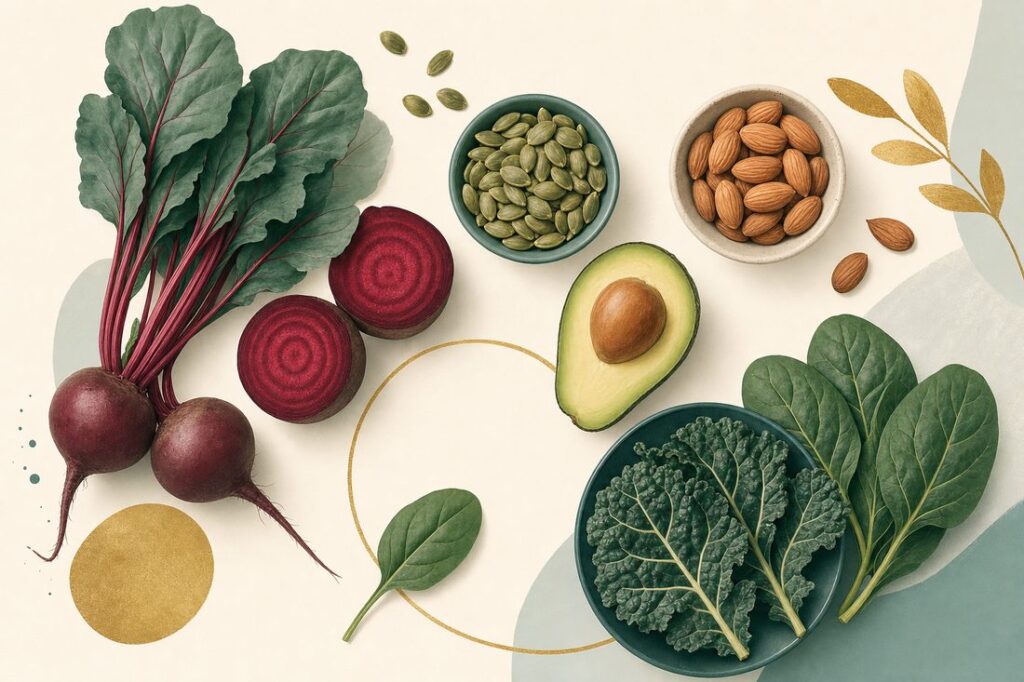
- Nitric oxide support. Estrogen was one of the main drivers of the enzyme that keeps vessel walls relaxed. With it gone, nitrate-rich vegetables, adequate hydration, regular movement, and reducing oxidative stress all become more important.
- Magnesium. It acts as a natural relaxant for vascular smooth muscle and plays a role in modulating the RAAS. It’s commonly depleted in women under chronic stress or on certain medications, and it’s rarely tested. One detail I care about: when it is tested, it’s usually serum magnesium, which can read normal even when tissue stores are low — so I’ll order an RBC magnesium when I actually want to know.
- Sodium sensitivity. After menopause, the kidneys handle sodium differently, and blood pressure can respond more strongly to dietary salt — even in women who weren’t salt-sensitive before. The threshold itself changes.
- Inflammation and the gut. A chronically activated aggressive arm drives inflammatory signaling, and there is growing evidence the gut microbiome directly influences RAAS enzyme activity. Dietary patterns, sleep, stress reduction, and gut health all move this system.
What’s right for any individual depends on her own picture — her markers, her inflammatory burden, her hormonal landscape. That is why personalization matters. What moves the needle for one woman may not be the right path for another.
Is Hormone Therapy Right for You?
The natural next question is whether hormone therapy — estradiol, estriol, progesterone — belongs in your plan. For some women it can be a meaningful part of the picture, and the conversation around it has changed considerably in recent years. But it is genuinely individual: it depends on your timing, your history, your risk factors, and your goals. This is the kind of decision that deserves a thorough, personalized evaluation rather than a one-size-fits-all answer.
A Physician’s Note
When a woman in this stage comes in with rising blood pressure, the first thing I look at is the trend against her own baseline — not just whether today’s number clears a cutoff. I’ll usually ask for two weeks of home readings taken at the same time of day before I read much into a single office measurement, because in perimenopause one isolated number tells me very little. I also don’t assume a creatinine drift from 0.7 to 0.9 is “just age” if it lines up with the menopausal transition; that’s a prompt to look closer, not to wait. And I’m careful not to oversell any single lever — magnesium, salt sensitivity, sleep, and inflammation each matter, but only in the context of the whole person in front of me. What genuinely helps one woman may not be the right path for another.
What to Take Away
If you remember nothing else: the years around menopause are a window where small, “still-normal” shifts in blood pressure and labs are worth a closer look rather than a shrug. The body in this phase isn’t failing — it’s adapting to a real hormonal change, and that change is increasingly understood. The most useful response is earlier attention and an individualized plan, not alarm.
At iVitality MD in Houston, Dr. Bismah Irfan helps women look at vascular function, inflammation, minerals, and the full hormonal landscape together, and decide what kind of support fits their biology. Book a consultation with iVitality MD →
Selected References
- University of Waterloo. How estrogen helps protect women from high blood pressure (sex-specific computational model of the renin-angiotensin system). 2026. uwaterloo.ca
- O’Donnell E, et al. Estrogen status and the renin-angiotensin-aldosterone system. PubMed
- Sex differences in the renin-angiotensin-aldosterone system and its roles in hypertension, cardiovascular, and kidney diseases. Front Cardiovasc Med, 2023. frontiersin.org
- Mayo Clinic. Menopause and high blood pressure: What’s the connection? mayoclinic.org
This article is for educational purposes only and does not constitute medical advice, nor a claim to treat or cure any condition. Hormone therapy, supplements, and medications can interact with other treatments and may not be appropriate for everyone. Always consult a qualified physician before starting or changing any therapy.
Frequently Asked Questions
Can perimenopause raise your blood pressure?
Yes. As estrogen declines in the years around menopause, the protection it gave your blood vessels fades, and blood pressure can rise even in women who never had an issue before. It is an underrecognized risk phase.
How does estrogen affect blood pressure?
Estrogen helps keep blood vessels flexible and supports the systems that regulate pressure. As it drops in perimenopause, vessels stiffen and pressure can climb, which is part of why cardiovascular risk shifts after menopause.
What can you do about blood pressure changes in perimenopause?
Monitor it, since the change is often silent, address the root drivers like stress, sleep, and metabolic health, and work with a clinician on whether hormonal and lifestyle support is right for you. It is a shift worth catching early.